Showing posts with label 1990s. Show all posts

Wednesday, December 18, 2024

How Many Levels of Nostalgia Are You On?


In the Greyhound Journal, two poems of mine have appeared. Both of them deal with historical memory. The first is called 1776 Versus John Adams/Boogie Nights Versus American Hustle, the second rolls out under the title Participation Prizes in Byzantium


Friday, August 25, 2023

Tuesday, March 23, 2021

Windows 96: Product Review


No, I'm not discussing a recently rediscovered lost Microsoft product from the Gold Age of Gates. The Windows 96 in question is both the name of a musical act, and the name of a poem I wrote about it. 

More specifically, I used the reaction of listeners to the music. My medium? Cutting up the comments they posted under the YouTube video for the album pictured above. A lot of nostalgia, as you can imagine. 

While the Comments Section lit mag is the first place to put this poem out in print or online, I actually read an earlier draft of this work at a reading hosted by Christine Stoddard at Unnamable Books in 2019.


Saturday, April 25, 2020

What's the Deal with Poetry

Some music to get you into the mood
Hello, and happy Saturday to those still observing the weekend. I just published a poem in The Daily Drunk involving a dream I had a while back. Somehow the show Seinfeld got involved, maybe I was watching reruns of it at the time.

Saturday, May 25, 2019

Part III: The Plain and the Mountain


In my last post, I discussed a tier of candidates who will pretty much do everything in their power to return the party to the 90s and keep it there. Whether it’s the 1890s or the 1990s is the main point of contention among them. None want to update the Democratic party to fit in with the values of its members, or confront a changing world. Their solutions are unworkable and their ideas are old. They believe in a return to a much-fabled normalcy, which is about as Utopian as the proposals of Fourier or Lyndon LaRouche. Putting them at the top of the ticket would be wrong and it would be a losing strategy, especially down-ballot.

Now we move on to those candidates who are slightly better than the Backset Democrats previously discussed. They at least understand the direction the party and the country are moving in (left, and towards disaster, respectively) and what to do to accommodate these changes. Some of them are fairly chameleon-like in their politics, such as Gillibrand, and that is worrying. However, this group of Democrats, are still amenable to pressure. They may not be ideologically committed to either change, nor the status quo, but they can be moved.

Call them the Progressive Centrists, although I think the term Centrist here has to be understood in relation to the party as a whole. It is not about left or right, rather the Plain and the Mountain. Students of the French Revolution will understand what I mean. Listeners of Mike Duncan’s podcast will too. The terms left and right are based on where people sat in the National Assembly in 1789. Supporters of the king sat on the right of the legislative body, those who wanted more radical changes sat on the left. Since then, we’ve come to use left-wing and right-wing to describe political beliefs. However, back in Revolutionary France, this distinction gave way in the subsequent National Convention, where delegates grouped themselves based on a different arrangement that was dictated by the particular seating of their meeting hall in the Tuileries Palace.

Here, there were seats close to the main dais, seats behind them, and then seats on an elevated platform around the room. Delegates chose to sit close together based on their beliefs, with the right-wing Girondins sitting together near the front and the left-wing Jacobins and others sitting in the gallery. In between them was the majority of the Convention, men who would vote with either faction. They became known as the Plain (or Marsh) while those radicals who occupied the galleries became known as the Mountain.

The reason for this little history lesson is that I think this arrangement shows how the factions in the current Democratic party operate. The National Convention in sense looks very much like a political convention today, with more conservative party leaders at the front and center, the party faithful representing states in the middle, and the activists and radicals in the rear and the galleries (the new Mountain). The candidates of the Plain represent those who believe in the Democratic Party, but also want it to do more. They are reformists and progressives of different stripes who are moved by the voices coming from the radical peanut gallery.

Here are the candidates of the Plain as I see them:

Kamala Harris
Kirsten Gillibrand
Andrew Yang
Bill De Blasio
Julián Castro

…and sometimes

Buttigieg (Schrodinger’s candidate)

Of course, unlike the Plain in the French Revolution, they are more willing to lead on their own terms, rather than allow others in the Democratic Party’s factions to dictate the direction of the party. They want to bring the left and right together in the spirit of common agreement on the common good in order to defeat Trump. They see the need to update the Party as well, and do things to appeal to younger voters. Hence you have Andrew Yang and his proposal for a basic income, and his internet-centric campaign. You also have Castro arguing for Reparations for African-Americans and Harris even talking about potential support for Medicare for All (though she’s walked that back recently, remember the Plain listens to both the Mountain and the donors up at the Dais).

They all have their problems, which is why I put them above the Backset Democrats and below the candidates who are either of the Mountain, or willing to come down from it. The first is that they do not go far enough to solve the problems of this country. The second, is that they are too willing to moderate themselves for the interests of the donor-class. The third is that most of them have been in office before and haven’t used it to try and advance their own agendas. Harris was a reactionary prosecutor. Castro didn’t do much about the affordable housing crisis at HUD. Gillibrand was a fairly conservative congresswoman when it came to immigration. Yang was a capitalist.

DeBlasio probably has the most progressive accomplishments of anyone running besides Warren and Sanders. However, what’s concerning about him is the lack of a structural vision for the government and the party. After all, he was hampered the most in office from a fellow Democrat: Governor Andrew Cuomo. It would be great if he could run with ideas about improving the power of cities and local government at the expense of states, and how to revolutionize the country’s transportation systems. DeBlasio’s a big guy, but he needs big ideas to stand out. Things could change. DeBlasio might start issuing one policy idea after another, making pledges left and right to the Mountain.

This primary has had an interesting effect so far, with candidates releasing all kinds of proposals in order to catch up with one another. Warren leads the pack here, with Sanders, Booker, Castro, Harris, and Yang behind. It’s an interesting contrast to the 2016 Republican Primary, where there were so many candidates running and hardly anyone felt the need to create any policy proposals. The only person with any ideas was Trump. They were all terrible, but no one was trying to meet him with ideas of their own. Consequently, it helped him dominate the discussion at the Debates. If anything, it shows just how intellectually bankrupt the Republicans are, and how “conservatism” in America has reached a complete dead end. Unfortunately, this sclerotic movement still holds sway over a major party, creating a situation I outlined in my previous post, where only one party has any real debate inside it, and then has to compromise with a party that doesn’t.

Oh well, now let us turn to our attention to the Mountain. This is where the activists, the radicals, the rabble rousers, and left-wing of the party sit. In the Convention, they are elevated, seeing all the action, but at a distance. Consequently their voices travel farthest and they are closest to the doors, making them the faction most likely to bolt if things go bad enough for them. The Mountain has its candidates, but I think it’s important to distinguish that they fall into to two groups. There are the candidates who are of the Mountain first and foremost and willing to stay there. Then there are those who have been on the Mountain, have seen the promised land, and want to lead the rest of the Democrats there. You can probably guess who I believe are in the latter group. The former includes the following:

Jay Inslee
Marianne Williamson
Tulsi Gabbard
Mike Gravel

What makes these candidates “of the Mountain?” Well I think in part its because they are identified with a particular issue. They are not generally interested, it seems, in advancing a broader set of proposals. Instead, they want to argue for a radical position in regards to a single problem facing the country. There’s nothing wrong with that, only that you can’t win the nomination this way, unless it’s 1896…the issue is bimetallism…and you’re William Jennings Bryan.

That said, I’d prefer these candidates over the Plain and the Backset Democrats. Why? Because they are willing to actually change the status quo on issues that have caused or will cause immense suffering here and abroad. One thing about the Mountain, is that it can look into the future and across national borders. That’s a strength, but the Mountain, like any political faction has its weaknesses. There’s the issue of seeing so far into the future, that they lose sight of the present. There’s also an impatience with the very mundane and boring aspects of politics and party processes. Finally, there can be a blinkered vision that focuses too much on a single issue (as vital as that issue might be).

As far as issues go, there are two main ones that define these candidates. The first is Climate Change, which is the center of Jay Inslee’s campaign. If the media really was as left-wing as conservatives say it is, and Climate Change the liberal conspiracy it’s supposed to be, he would be getting far more attention than Pete “the South Bend Mr. Bean” Buttigieg. Inslee understands there is a problem and it has to be confronted by all necessary means and at all deliberate speed. It’s a real issue, not like “radical Islamic extremism” or whatever combination of words thereof conservatives think you need to say to defeat terrorism. If I had to have a single-issue candidate in office, he’d be the one. Nothing else is as important.

Then there are two candidates who represent the Mountain’s views on foreign policy, more or less. The less is represented by Tulsi Gabbard. The more is being pushed by Mike Gravel. They want an end to interventions in other countries, though Gravel is willing to go much farther than Gabbard. It’s unclear how strenuous her opposition is. Is she against certain current engagements but fine with the overall size of the armed forces and the powers of our intelligence agencies? Mike Gravel is the only one who is clear on reducing everything, bases, invasions, incursions, and budgets. Unfortunately, he’s too old to be president and his campaign is more meme-powered than anything else. He represents the Mountain at it’s highest peak. Incredibly serious about the issues, not serious enough about the process.

Finally, there’s Marianne Williamson. I don’t know what to make of her or how to describe her policies. Again, it’s another peak Mountain campaign. She has a firm commitment on reparations. However there’s also an emphasis on New Age mysticism. In the past she’s described herself as a “bitch for God,” so there’s that too. Maybe she can help reclaim religion from the right, if nothing else.

Friday, May 24, 2019

Part II: The Lamestream of Backset Democrats

Here is where I begin my analysis of the candidates in the race and try to convince my fellow Americans, why there are only two people worthy of having their name at the top of the ticket. Maybe I don’t have a network behind me, but I think I am just as insightful as Jonathan Chait or Chris Cilliza or Cilia or Cilicia, whatever it is. I’ve examined the field of political ideologies thus far, and I’ve read the Wikipedia articles on every single American president, election, primary, and convention. That must be more than any of the so-called experts have achieved. For instance, despite their myriad analyses, few of them have mentioned the 1924 Klanbake.

The term, “at a crossroads” is often overused. It is often misused too. Sometimes people forget the origin of the phrase goes back to the play Oedipus Rex. Specifically, it describes the scene where Oedipus unknowingly kills his father Laius, at a crossroads. He then sells his soul to the devil in order to play the blues lyre so he can bring his wife back from Hades. The band Cream made a song about it. But the truth is the Democratic Party has to decide what it believes and what it wants to fight for. Opposition to Trump isn’t enough. Although Trump might be at the top of the ballot, there’s so many other races to consider. The Democrats have to get people out to vote for them. This requires a unified vision and platform people can get excited about.

The party can’t assume people will vote for their slate of candidates just because of Trump. Given our polarized state-by-state elections, there’s plenty of people who might not come out to vote for the Democratic candidate for President if they think the state they live in will go out for him or her anyway. But in doing so, they will ignore all the races down-ballot the Democrats need to win. You know, the races the Democrats used to care about winning. I’m talking State Senators. Aldermen. Comptrollers. Clerks of the Court. (and no, not dog catcher. That’s not an office that’s actually up for the ballot anywhere.)

The Democrats can’t win these without someone who gets people excited, even in blue states. The leaders of the DNC will deny it and the pundits will ignore it, but the truth about politics these days is that you don’t win by appealing to some mythical center. You win by getting your base out to vote. The Democrats, ostensibly being the party of “the people” should have more voters in this scenario. You’d think they’d understand that and push for it, but alas that seems to be beneath the current leadership. As we saw in 2016, they were more interested (as in Chuck Schumer’s analysis) to give up blue collar votes in the Rust Belt in favor of mythical Republican moderates in the suburbs of Philadelphia and Cleveland.

In this portion of my ongoing series on the candidates, I’ll look at the candidates who are…well…meh. These are the men and woman running who can’t really articulate what they will do differently in the White House and what makes their approach to the issues and the electorate more than just a repeat of Hillary’s disastrous run in 2016. They can’t even really explain what makes them unique from one another. Why so many of them are running might be the biggest mystery of the 2019-2020 primary. Here are their names, the absolute meh tier:

Seth Moulton
Eric Swalwell
Michael Bennet
Steve Bullock
Amy Klobuchar
Cory Booker
Beto O'Rourke
Wayne Messam

…and sometimes

Pete Buttigieg

Are they being goaded to run by some entity within the party? Is the DNC or some faction thereof responsible? And if so, are they failing to communicate with one another? It’s hard to explain this phenomenon. We have so many people running for such a small piece of electoral real-estate. Sure, the big donors are all there, but the voters? They’ve largely gone over to the more liberal, progressive, or outright leftist wings of the party. Yet here we have several candidates essentially trying to resurrect Clintonian triangulation and the 1990s. The trouble is, Bill could only do what he did thanks to a particular combination of demographic and economic factors three decades ago. Plus, he had charisma. None of these people running in the Neoliberal lane have anything approaching the personality Bill Clinton displayed.

They also seem to collectively forget how much of a disaster Bill was for the long-term health of the party. Sure, they won the presidency. Then they lost Congress. That consolation prize seemed to be worth it, until they lost the presidency under Al Gore anyway. As a result, America ended up with an emboldened right-wing Republican Party in control of this government, and the ones in Iraq and Afghanistan. There was a brief window of opportunity to realign the country again under Obama’s first term, but what happened? More triangulation, more surrender to Wall Street, and more foreign entanglements. Instead of breaking with Clinton’s Neoliberalism, Obama sought to reinforce it with a kinder face. Now we’re reaping the proceeds of this continued failed strategy. Trump is in the White House. The Conservatives have hijacked the Supreme Court. The GOP controls the preponderance of state houses and governorships across the country.

It is true that once more, the Democrats have Congress to try and stand athwart the Republicans and yell “stop!” But the victory in the 2018 midterms had more to do with disgust and frustration over Trump and the Republicans, than any genuine enthusiasm for the Democrats or their policy.  It can’t be used as a barometer for the voters, or would-be voters in 2020. It certainly shouldn’t be seen as a desire to return to the triangulations of the 1990s and the compromises of the aughts. However this first batch of candidates are clamoring for the presidency under the assumption that what Americas want are grand bargains, entitlement cuts, endless “smart” wars, and the last full half-measure of devotion to the New Deal.

Now I’m being generous. I’m assuming they’re running because they believe in all that and believe that’s what’s best for the country. Maybe they really all want to Vice President. Maybe they are hoping to get a book deal out of their runs. Maybe it’s just pure ambition, which most politicians have, and it only seems like so many mediocre people are running because the Democratic Party has a surplus of mediocre people. It could be that an army of overpaid consultants see them as easy marks, and have goaded them to run in order to line their own pockets.

Sure they will argue they have certain advantages and offer up diversity to the field. In some cases, like Cory Booker, it’s true. Buttigieg too, we can’t forget him (because the media won’t let us). In others, they do represent regions of the country outside the usual “Blue States,” though how that will translate to victories in other states (or even just their own) is unclear. Then there are candidates running on their youth, despite not believing in anything young people want. There’s a veteran or two in there as well. They want to be John Kerry 2.0 it seems.

Collectively their problem is a lack of substance, that points to new ideas, a clear vision, and how to restructure and rebuilt America. At best, what they have are piecemeal reforms. At worse, they will put a happy face on privatization and austerity. This might be the solution to the mystery I mentioned earlier. Maybe so many of them are being encouraged to run by the party so they can put a damper on the whole race. That would explain the strangely high number of them throwing their lanyards in the ring. They are here to crowd out the debate stage and tell us we can’t have nice things. If things get too rowdy in the primary, their role is to remove the punchbowl.

To give any of them the presidency would be a disaster for the party, for the progressive movement, and for the country at large. Given the looming ramifications of Climate Change, they are also a disaster for the world. Why? Because they are the apotheosis of the two trends that have been ruining the Democrats since 1992. The first is ideological. They are proud defenders of Neoliberalism, although their version is just a rehash of an already dated revival. They want laissez faire at home and intervention abroad, open boarders to capital and gated communities for labor. The market over all, yes, and that means you. The Democratic Party not only gave free reign to “free” markets in the 1990s, it did so back in the 1890s as well. That was the heyday of the Bourbon Democrats. But these Democrats are worse than Bourbons, at least the Bourbon Democrats opposed imperialism and interventions. These are Backset Democrats.

The second tend they embody is functional. This pertains to what the role of the Democratic Party should be in our system, regardless of its ideology. Instead of being a vehicle and a catalyst for change, these Backset Democrats want a party that acts a gatekeeper to activist groups. Within the party, they want to defend the leadership up at the Dais from challenges coming up the aisles. Whether these movements are for labor, civil rights, peace, or the environment doesn’t matter. It’s a familiar story that’s happened since the 1960s. Activists and movements reach out to the party and in the end get co-opted by it. Seeking power to effect change, they find themselves blocked by the Democrats who now demand votes from them in exchange for progress. In the end, the Democrats capture these movements and hold them hostage. The threat of a Republican victory is used to keep them in line.

The Backset Democrats want to maintain this version of the Party. To a lesser extent almost all the Democrats except Sanders and Warren want to too. But the Backset types, along with Biden and his clones believe this is the only way the party can function. It is the Divine Right of the DNC. They want a party that is muddled, confused, and watered-down. They want a party constantly compromised by itself. While they may think this makes the Democrats seem reasonable, or that this will make their proposals look better, in effect, it just leaves things open for a further compromise with the Republicans to drag everything farther right. What the Backset Democrats fail to realize is that no one is impressed by how much debate occurs within the Democrats to produce a policy. It certainly has no bearing on the further dialectic with the Republicans.

In a way, it is a good thing so many of this type of Democrat are running. It might deprive Biden of some support, especially in regards with endorsements. However as I mentioned above, so many Backset Democrats on the Debate stage might just add more opportunities to prevent an actual discussion of the issues. If there has to be constant debate within the party, it should occur without their hand in it. It is true that the only serious discussion of politics in this country is happening within the Democratic Party. It’s an unfortunate situation. I’d rather have a Republican Party where all the Neoliberals could dwell, leaving a Progressive Democratic Party behind for good. But that doesn’t mean the Democratic Party should support a failed consensus in the meantime or weaken its commitments.

Some of these men and women running have tried to be dream candidates by checking off what they assume to be a list of boxes in the minds of voters. Mayor Pete is probably the most egregious example of this. It’s an unproductive exercise for candidates and the voter. What is needed are not dream candidates, but candidates who dare the voters to dream of a better world. The Backset Democrats don’t want that and we shouldn’t want them because of it.

Saturday, April 21, 2018

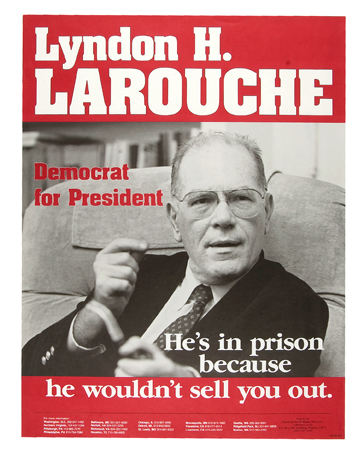
Trump's 2020 Campaign Poster

If let's Make America Great Again could be taken from Reagan:


Then his 2020 Campaign can steal from Lyndon LaRouche: