Showing posts with label crime. Show all posts

Wednesday, May 29, 2024

A Story to Go with Your Garbage Plate


It's something lickin' good

Rundelania, a journal based up in Rochester, NY, published a short story of mine. It is called "Blended Bifocal," It's about dirt, coffee, jogging, pipes, and more dirt. Bonus points if you can spot the Norman Mailer reference.

Monday, November 13, 2023

A Short Story About Eyewear


Hey all, Rundelania has put up a short story of mine "Blended Bifocal." Read about the excavation of a gas pipe gone wrong (NSFW?) 


Friday, October 20, 2023

Hey True Crime Fans


Hey true crime fans, here's a poem I wrote that Dark Entries Journal liked! It is about the collection of various forms of detritus serial killers leave behind. Read it and consider the costs of celebrity culture and consumerism.


Wednesday, August 9, 2023

Murderabilia by Ben Nardolilli


New poem in Dark Entries called Murderbilia, which deals with the phenomenon of collecting items related to serial killers and other notorious persons. 

Saturday, June 4, 2022

Fresh Words from a Fiery Scribe


A soul is for sale and a guilty party pleads in front of a judge in poems of mine published at Fresh Words. Meanwhile a man with a lease speaks over at the Fiery Scribe


Tuesday, April 26, 2022

Too Many Notes and Such Small Portions


Thanks to Diet Milk Magazine for publishing a poem of mine called Open Pit

April brings poems to share with you. There's the publication pictured above, but there's more! Two poems are in Parish Line Press, one of which involves the Ancient Greeks. Then there's a poem at Write Now Lit. It mixes real estate and true crime. 


Monday, June 18, 2018

Denis Kearney: America’s First Fascist?

The Subject of Tonight's Essay, who I originally learned about on The Dollop
In this essay, I will be exploring the nature of Fascism and how it applies to the political life and times of Denis Kearney. I will argue that he can be regarded as America’s first Fascist, albeit with some important reservations. Exploring his rise and fall in obscurity is important because it shows how Fascism can and will take root in America if we’re not careful.  The fact that few Americans have heard of Denis Kearney is both good and bad. Good, because his successes were few and his fame fleeting. Bad because by forgetting him, we forget an unpleasant part of our past. When we do that, we become more likely to repeat it.

In short, Denis Kearney was a 19th century demagogue who organized the Workingmen’s Party of California (WPC). Comparison with the Know Nothings are valid to a point. Like the earlier Know-Nothings, the Party was driven by hatred of perceived outsiders. However their prejudice was based in Racism instead of religion. In particular, they opposed Chinese immigration (there was a Know-Nothing movement in San Francisco that also hated the Chinese, but it was a small part of a national Anti-Catholic movement). Unlike the Know-Nothings, they were not a national party. They were only strong in California, but still sought a nationwide ban on the Chinese coming to the United States

Another important difference between the WPC and Know Nothings was its class character. It was mostly made up of urban laborers and craftspeople, with a heavy concentration in San Francisco. In contrast, the Know Nothings included people from a variety of economic backgrounds. In New England, there were members who were factory workers, teachers, and ministers. In the rest of the country they included factory owners and merchants, as well as slave-owners in the South. This gave the Know Nothings a more varied platform. Not only did they oppose Roman Catholicism and the Irish, the movement also took on different causes depending on the area. Know Nothings were known to fight for railroad regulation, clean government, and prohibition.

We see how the WPC was different from the Know Nothings. They were more racial in their worldview and they presented a working-class character.  In a sense they were a bridge between Anti-nativist movements of the mid-19th century, and Fascist groups in the 20th. In that way, they could be compared to the Klan. The WPC differed from this organization as well, because it was explicitly party based (the Klan supported Democrats in the South and Republicans in the Midwest) and it didn’t utilize any specialized garb, gab, or rituals.

Yet despite being a bridge of sorts to 20th Century Fascism, the WPC can be seen as close as a group could get to Fascism in the 1800s in America, before anyone knew the term.  Now, Fascism is a contentious term and nobody can agree on its definition. The label of “Fascist” gets thrown a lot and many different kinds of being and movements are labeled with it. I try to limit my usage of it to certain specific characteristics. For instance, I wouldn’t label the Klan, Donald Trump, William F. Buckley, the John Birch Society, or Pat Buchanan Fascist. They are Conservatives of different stripes. I would label Steve Bannon, Richard Spencer, and the figures of the Alt-Right Fascist. What’s the difference?


The difference comes down to an approach to hierarchy in a Capitalist system. Conservatives want to preserve it. Fascists want to purge it. For added comparison, Liberals want to reform it, and Radicals want to overthrow it one way or another. Take Hitler’s view on the bourgeoisie of his time: “Today’s bourgeoisie is rotten to the core; it has no ideals any more; all it wants to do is earn money and so it does me what damage it can.” Like a typical Fascist he sees them in need of correction and subordination, but not elimination. He reserves that level of ire for the Jews, regardless of their economic class.

Yet Conservatives and Fascists both sit on the political right and have the same political enemies, that doesn’t make them natural allies and it certainly doesn’t make them the same. Even Conservatives who support authoritarianism aren’t Fascists. It brings them closer to it and creates a risk of tipping over into Fascism. It still doesn’t make them Fascist. For instance, a Conservative may want to preserve an absolute monarchy. Fascists, meanwhile, want to keep Monarchs out of power. They see royalty, nobility, and other forms of aristocracy as examples of degeneration within the elite.

Of course, Fascism’s support for Capitalism doesn’t make all Capitalists Fascists either. And yes, Fascism does support Capitalism, and no, Fascism and Socialism aren’t the same thing. Fascism can appear to look like Socialism because of its opposition to Liberalism, especially liberal Capitalism. Fascists attack the banks, they attack trade deals, and they criticize unemployment and exploitation. However, this isn’t because they are Socialists. They attack these things because they are viewed as threats to the mythical Nation (e.g. the German or Italian people) and the hierarchy within its borders. So banks are bad because they put the Nation in debt to people from outside it (i.e. Jews). Trade is bad because it weakens borders. Exploitation and class conflict are bad because they weaken cohesion within the Nation, and so on. 

The Statist and Capitalist nature of Fascism is best evident from the writings of its leading figures. As Mussolini says in his 1915 Doctrine of Fascism: “If the 19th century was the century of the individual we are free to believe that this is the 'collective' century, and therefore the century of the State,” or as he put it more directly, “everything in the state, nothing against the State, nothing outside the state.” Yet this state still has its classes and a fundamentally Capitalist character. This is why someone like Ludwig von Mises could support Fascism as a temporary fix to beat back any Socialist or Communist threat during the 1920s.

Any rhetoric about class, exploitation, or opposition to banking which Fascists espouse has to be squared with this. People often mistake (sometimes rather deliberately) what Fascists say for what Socialists do. Both groups are interested in class conflict under Capitalism and both groups have different approaches to the issue. Socialists want the working class to overthrow and displace the bourgeoisie as owners of the means of production. Fascists want to organize the classes of society in a way to promote the harmony of the State. This is usually done by unifying people against a domestic enemy (such as Communists or Jews), and a foreign one as well (such as the British or the Soviets).  Fascists may show support for institutions such as unions, but this support is not related to any emancipation of the working class from Capitalism. As French thinker Charles Maurras, explained what Mussolini’s Fascism sought in trade unions:

“A trade unionism free of the chains of the class struggle had imposed on Italian labor. A methodical and successful will to bring together in a same fascio all the human factors of national production ... A determination to approach, to threat, to resolve the worker question in itself ... and to unite unions in corporations, to coordinate them, to incorporate the proletariat into the hereditary and traditional activities of the historical State of the Fatherland.”

Fascism still believes in private property, class divisions, and private ownership of the means of the production. Hence it is not Socialist. It is not Liberal, either, because it subjugates the Market Economy to the State as the manifestation of the will of the Nation. It does not abolish it either, which puts Fascism firmly in the Capitalist camp. The Capitalist class understands this. That is why when forced to choose between a revolution on the Left or a revolution on the Right, they choose the one on the Right and as individuals, they hope they do not meet the local Fascists’ definition of degeneracy. 

As we can see, one of the key aspects of Fascism is its reactionary character. Not just in a political sense, but also in the historical sense as well. Fascism is a reaction to Socialism and Liberalism, and the perceived failure of Conservativism to respond to both. This makes it difficult to classify groups before Mussolini as Fascist. The Workingmen’s Party of California is no exception to this. In an era before the rise of Socialism, Communism, and Anarchism as serious threats to the political order, can Fascism be said to exist? The idea of when an idea constitutes a challenge or a threat is open to debate. In 1850, the radical left existed but had yet to take power in any real sense across the world. By 1920, that situation has changed thanks to the Russian Revolution. When the WPC was active though, this threat existed in a hazy area. Using the old Terror Alert system, one might say it was Elevated, rather than Severe. After all, the Paris Commune was a recent memory.

I think it’s important to keep this fact in mind. In the 1870s, There was a generalized fear of Left-wing movements. You can see this in a cartoon by Thomas Nast I posted below.  In it, he equates the WPC and the new state constitution they passed with Communism and Anarchy. This is an early example of Horseshoe Theory, equating the far Left with the far Right. Nast can be forgiven for engaging in this fallacy though, since there was no concrete Fascist movement to criticize. One could only go by rhetoric. However, make no mistake about it. The nature of the 1879 Constitution the WPC helped to pass is a reactionary and racist one. It has a whole section (Article XIX) dealing with Chinese Californians. Mostly it strives to prevent them from becoming employed.


How the Political Mainstream Saw Denis Kearney and the WPC
And with that, let’s move on to the case of Denis Kearney (1847–1907)
As mentioned before he was a demagogue who rose to political prominence in California by attacking Chinese Immigrants. One might think he was born in California itself, since he was so adamant about protecting it from foreign influences. Nope. Denis Kearney was born in Oakmount, County Cork, Ireland in 1847. An immigrant attacking other immigrants for not being American enough? Only in America. Kearney took a job on a clipper ship as a young boy and claimed to have sailed around the world. He jumped ship around 1868 and ended up in San Francisco, where he became a citizen and started a business hauling freight by wagon. By 1877 his business was so successful he owned five wagons and moved goods all over San Francisco.  

1877 was also the year he made his first foray into politics. As San Francisco and the country were dealing with the effects of an economic depression, Kearney challenged city-backed monopolies on transporting, carting, and hauling goods. Over time, he was drawn into more radical politics. While he was not an outright Socialist, he did side with the city’s working class against the wealthy. That summer, a group of Socialists from the national Workingmen’s Party (later known as the Socialist Labor Party of America), held in a rally in the so-called Sandlot near City Hall. The speakers urged working class unity and an end to exploitation by Capitalism. 

A group on the outskirts of the meeting started asking about how to handle the Chinese population, blaming them for the unemployment problem in the city. The organizers refused to acknowledge them and tried to maintain order. The Anti-Chinese group left the rally and proceeded onto Chinatown, where they started a two-day pogrom that had to be quelled by the state militia with the help of locals who had organized an ad hoc brigade armed with pickax handles. 

The event appears to have further radicalized Kearney, who was one of those who served with the pickax brigade to maintain order. He saw the power of harnessing Anti-Chinese feeling in the city and the appeal of Socialist ideas. He tried to join the National Workingmen’s Party but was denied for his Anti-Chinese prejudice, and previous statements condemning the laziness of the working class. Undeterred, he formed the Workingmen’s Party of California and began a quick rise through the city’s political ecosystem. His speeches did stress labor issues at first, yet this was a halfhearted commitment, since he was critical of unions and denounced strikes.  Eventually working-class concerns faded to the background and the Sinophobia took center stage. 

This was despite being a minority himself. San Francisco was far from the liberal beacon it is today and anti-Irish prejudice was common, just like in the rest of the country. Members of the city’s elite, who might’ve harbored Sinophobic views themselves, distanced themselves from Kearney’s movement because of his Hibernian roots. Contemporary author Hubert Bancroft, considered the WPC to be “ignorant Irish rabble, even though that rabble sometimes paraded the streets as a great political party." Other critics disliked Kearney’s brash rhetoric and saw him as the perfect representation of Irish American stereotypes. To many White Anglo-Saxon Protestants, it was Kearney and his fellow Irish who were the real risk to American Democracy, not the Chinese. They were aggressive, and quarrelsome drunkards who lacked the steady emotional and rational reserve of good Protestant stock. Hence, the reason they were behind corrupt political machines, such as Tammany Hall.

How Thomas Nast saw the Irish, which was pretty typical of WASP Republicans
Despite this criticism, Kearney’s movement grew in support. He regularly spoke to hundreds of people at the Sandlot, stirring up crowds with Anti-Chinese rhetoric. While he did show contempt for the press, capitalists, and the political establishment, Sinophobia was the continuous thread running through all his speeches, trumping all other things he hated. They were the “other” that consumed his attention.  Their mere presence in San Francisco, and America at large was intolerable. Kearney often ended his speeches with "And whatever happens, the Chinese must go," an echo of Cato the Elder’s attacks on Carthage, as well as a preview of Hitler’s attacks on the Jews. This eliminationist discourse is classic Fascism and can be contrasted with the emerging system of Jim Crow in the South. Being a Racist does not necessarily make one a Fascist. An extra step is needed to reach that level of prejudice. As violent and oppressive as the Klan and other Redeemers were, they did not want to rid Dixie of its Black population. They were too important to the local economy. However, Kearney sought the expulsion of every last Chinese person from America.

Just like the Nazis, Kearney framed his prejudice in terms of a question. In this case it was the “Chinese Question,” rather than the Jewish one. Of course, by referring to relations with the Chinese community this way, he could presuppose a problem on their end, and demand something be done about it. Just like the Nazis, and other Fascists, he placed this “Question,” above all other issues. To him, it was of paramount importance:

“When the Chinese question is settled, we can discuss whether it would be better to hang, shoot, or cut the capitalists to pieces. In six months we will have 50,000 men ready to go out. . . and if ‘John’ [the Chinese] don’t leave here, we will drive him and his aborts [sic] into the sea… We are ready to do it… If the ballot fails, we are ready to use the bullet.”

This is Kearney engaging in a common Fascist tactic, taking in the grievances shared by the lower-middle class and the working class and directing their anger at a completely unrelated target. The threat of the Chinese is played up to a fever pitch and dealing with it is so vital, that if Democracy cannot solve it, then violence is necessary.

Violent rhetoric against the political system was a common theme in Kearney’s other speeches. It often got him in trouble with the law but he was always released after being arrested. No one would testify against him. Here are a few gems of Kearney’s rabble rousing:
“Shoot the first man that goes back on you after you have elected him intelligently…see that you hunt him down and shoot him.”
“…before I starve in this country I will cut a man’s throat and take whatever he has got…The Workingmen’s Party must win, even if it has to wade knee deep in blood and perish in battle.”
  
“When I have thoroughly organized my party, we will march through the city and compel the thieves to give up their plunder. I will lead you to the City Hall, clean out the police force, hang the Prosecuting Attorney, burn every book that has a particle of law in it, and then enact new laws for the workingmen.”
“For reporters of the press I have great respect. The reporters of the newspapers are workingmen, like ourselves ‒ working for bread and butter. But for the villainous, serpent-like, slimy imps of hell that run the newspapers, I have the utmost contempt.”

Ironically, at one point early on in his political career, Kearney urged laborers to be "thrifty and industrious like the Chinese.” It was a short phase and by 1878 he was demanding that the railroads fire all their Chinese workers, and threatened lynchings if no action was taken. Taking advantage of the depression of 1873-1878, the WPC won elections and took control of the process to draft a new Constitution for the State of California. It combined Xenophobia with a strong anti-monopolist stance. For instance it banned railroads from hiring Chinese workers and put them under a California Railroad Commission that would regulate other business practices to make rates fairer to consumers. Kearney tried to spread his political message to other cities and increase his national stature, to limited success. He brought out crowds in cities such as Boston, but this enthusiasm failed to create a lasting political movement. The WPC would remain confined to California. Kearney shifted gears and tried to get the Greenback Party’s nomination for VP and failed in this endeavor as well.

Kearney remained in San Francisco where his political star continued to fade. Although he managed to get the Chinese Exclusion Act passed in 1882, his local laws and initiatives were overturned by the courts. Meanwhile, Chinese-American civil rights activist Wong Chin Foo would become a thorn in his side, attacking Kearney for his prejudices against his people. In 1883, Wong challenged Kearney to a duel, offering him his choice in weapons. These were Chinese chopsticks, Irish potatoes, or Krupp guns. Kearney, ever eloquent, called Wong an "almond-eyed leper." In his 1887 essay, Why I am a Heathen, he argued against Christianity using the example of Denis Kearney. In a fanciful speculation, he believed that under Christianity was possible for Kearney to repent his bigotry on his deathbed and then enter into heaven, where he could proceed to organize another mob to expel the Chinese. Kearney died in 1907, believing his work was instrumental in putting the “Chinese Question,” before the public. Today there is a Kearny Street running through San Francisco’s Chinatown, but it is not named after him. Most likely it is named after Mexican-American War Army officer Stephen W. Kearny.

The rise and fall of Denis Kearney and the Workingmen’s Party of California are important to remember when considering the possibility of Fascism in America. Yes, they were Fascist, or as Fascist as one could be at the time. To make a comparison to music, they could be described as Fascist the way the Stooges could be described as Punk. Chronologically they were off, but temperamentally they embraced the same basic template. They were political outsiders looking to transform the government by any means necessary, hence a revolutionary and not Conservative movement. At the same time, they were not arguing for changing the fundamental economic system, despite their attacks on the rich, which made them different from Socialist groups. Kearney and the WPC went beyond the racism of the day and wanted to expel a group from California, a trait seen in the ethnic cleansing espoused by figures like Adolf Hitler in Germany and even Mussolini in Libya. Kearney did not care for reasoned debate, and embraced a politics of pure emotional spectacle at his rallies, another trait reminiscent of other regimes in the 20th Century.

Yes, contemporaries accused Kearney and his party of being radical Communists. But this ignored the WPC’s deeply reactionary politics on race, which functionally made them a right-wing, not left-wing party. This failure to understand the movement only increased their appeal to a working class who felt they were being left behind in America’s rapidly industrializing economy. This is a mistake that proponents of the Horseshoe Theory make. Instead of accusing Fascists of class charlatanism and exposing them for what they are, Horseshoe Theorists lump them with Socialists, mistaking rhetoric for action. This ends up hurting the Left and helping Fascists gain support. If the far-Right and the far-Left are equal ideologically and occupy the same political space, then Fascists can gain the upper hand over Socialists. They can do this because they often operate with the support of the wealthy, certain segments of the media, the military, and law enforcement. This allows them to take working-class anger and turn it away from the system and towards an out group, such as Jews, Muslims, immigrants, or Gays.

Denis Kearney not only shows the possibility of a Fascism in America we must be vigilant about, but also the ways Fascism has been limited so far in this country. Despite plenty of racism, prejudice, and fear of Socialism, why have we avoided Fascism? The limitations of Kearney’s movement reveal part of the answer. Tensions with the White community were probably the largest barrier to his rise as a national figure and the WPC as a national movement. Until the election of John F. Kennedy in 1960, Catholic and Protestant divisions would’ve stopped any Fascist movement from gaining too much power. A figure like Denis Kearney, or later on, Father Coughlin, would’ve been constrained to support among Catholics. Meanwhile a group like the KKK couldn’t branch out beyond Protestant communities. There were additional ethnic issues as well, with Southern and Eastern Europeans distrusted by those of Northern European ancestry, and vice versa. Now, things have changed. White Americans no longer are as divided by religion or national origin as they once were. This is good for many reasons, yet it presents the possibility of mobilizing White Americans as a political group nationally for the first time in this country’s history.

Another issue limiting the spread of Fascism has been the sheer size of this country. It makes it harder to organize a national movement due to cost and the likelihood of rival groups with similar politics appearing in other regions. It makes centralizing power, a necessity of Fascism, difficult to achieve. If Kearney turned the WPC into the WPUSA, he would have to contend with Party bosses in New York, New England, and the South. To be sure, the Constitution also poses an institutional challenge. Checks and balances and all that. Yet American history is riddled with plenty of Supreme Court rulings that empowered authoritarianism in the Presidency as well as instances of Congressional cowardice in the face of the Executive overreach. Revanchism is missing too. Unlike Germany or Hungary after WWI, or Italy after the Fall of Rome, American has never lost a major war (only police actions). Therefore the appeal of a Fascist movement promising to restore national glory is limited. How long that state of affairs lasts is anybody’s guess. A defeat by Iran could lead to the rise of someone ever farther to the Right of Trump, who is better organized in both mind and movement.

Sinclair Lewis once argued that when Fascism comes to America, it will be carrying the flag and the cross. I think the example of Denis Kearney illustrates that the cross is not necessary at all. Nationalism and racism will be all that is necessary, since religion would be too divisive to build a movement. Anti-Catholic and Anti-Irish feeling prevented Kearney from using Anti-Chinese fervor to catapult himself to a national office. Kearney shows that not just any old racism will do either. It must be a racism that is about more than White Supremacy. It will be part of an ethnic cleansing campaign, in this day and age linked to our current geopolitics. The out group under attack has to be one seen as a fifth column undermining the nation.  Perhaps it will be Muslims or Chinese-Americans, or both. If the economy is tanking, look for this movement to speak the language of working class grievance. It may even be called Leftist, because of vague attacks on Capitalists. But when that day comes don’t be fooled. In dealing with Fascists, look for their specific targets that receive the most detailed attacks, both in speech and in physical form. That list will most certainly include ethnic and religious minorities, as well as any genuine working-class movements that are present. Because as the reactionaries know, these are the only real antidote to Fascism.  


Saturday, April 21, 2018

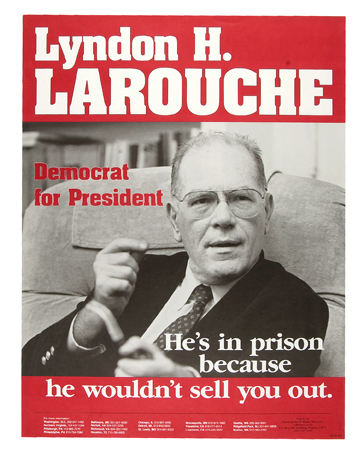
Trump's 2020 Campaign Poster

If let's Make America Great Again could be taken from Reagan:


Then his 2020 Campaign can steal from Lyndon LaRouche:


Sunday, October 15, 2017

I Wrote a Spoof


To the tune of "I Pity the Poor Immigrant"

I pity the poor president
Who wishes he would've stayed home
Who uses all his power to do evil
But in the end is always left so alone
That man whose tiny fingers cheats
And who lies with every breath
Who passionately hates his wife
And likewise, loves immigrants’ death

I pity the poor president
Who does nothing but complain
Whose chief enemy is poor ratings
Whose tweets are insane
Who rules but is not satisfied
Who fears and is never free
Who goes to fight with truth itself
And breaks the law with glee

I pity the poor president
Who drags us through the mud
Who steals and golfs while laughing
And who covers other lands in blood
Whose rule in the final end
Must shatter like the glass
I pity the poor president
When our judgment comes to pass

Wednesday, August 7, 2013

Get Lucky with Blurred Lines

I haven't posted anything in a while and I haven't posted poetry in an even longer time. But seeing Stephen Colbert using Henry Kissinger for his much praised performance, I don't know. It just disturbs me, along with the way everyone who is supposedly leftist and liberal looks past it. Then again, without amnesia, how could we expect Hillary Clinton to be president in 2016? She'll be making history then, as long as we can ignore the history she helped make in Babylon. I dread the day George W. Bush gets to trot out his imbecilic grin and give voice to it on the Simpsons Treehouse of Horror LVII. It will be heralded, maybe even nominated for an Emmy. So it goes. 


Get Lucky with Blurred Lines

You tell yourself he cannot be an Eichmann, no,
He is a Jew and an old Jew at that,
An old Jew could never commit such terrible crimes
Not for the banal reason of an promotion, a desk,
Evil always has an ideology behind it, at least
Evil in America needs a cross to rally behind or burn.

And he can easily go along with the joke, evil
Never jokes, never makes a cameo,
Evil demands the spotlight, it demands to be a star,
Of course you are a star too, with a show,
A show where you dance with him while an audience
Too young to remember a secret bombing laughs.

The script calls for him to call for security
To escort you from the premises,
Decades ago, he called on friends in other countries
To overthrow their presidents, fill stadiums up
With folksinging hooligans and gun them all down,
Perhaps you want to highlight the contrast?

Here he is now, harmless like an urchin,
A buffoon who might even drop his glasses in a toilet,
An elder statesman with his gravitas swinging
Like a snood tucked under his pale chin,
You are old enough to remember beauties hooking
Their arms with him to promenade down  red carpets.

He gives off no aphrodisiac now, not for you, no,
You dance too quickly for him to catch you,
Even if the camera lingers, the smell does not reach you,
You are too busy, you must go embrace an actor,
Meanwhile, the urchin leaves his desk behind

To sway a would-be candidate waiting in the wings.

Tuesday, February 19, 2013

Tuesday, July 31, 2012

The Time for Justice: A Book Review


Hello there my longtime readers and my (as of this writing) 52 followers! Today I am inaugurating a new feature for this blog, book reviews. It seems my name and website have gotten into the hands of numerous esteemed publicists and they are clamoring for me to say a few things about the books by the authors they represent. Since I have nothing much else to do these days except wait for literary stardom and attendant publicists of my own, I have decided to give this new project a go.

The Time forJustice: How the excesses of time have broken our civil justice system, (Onward Publishing, 185 pages) is a new non-fiction book by acclaimed lawyer Anthony V. Curto, written with the assistance of Ronald E. Roel. Mr. Curto has worked for several decades representing clients as diverse as Ted Turner, Linda Lovelace, and Alexander Solzhenitsyn and has an insider’s view of the problems that have plagued our civil justice system for several decades.  Curto reduces these issues to one chief obstacle: time. Specifically, the way time is used to prevent settlements from being reached and enforced in a manner that helps those who need them.

While the shortcomings of our criminal system often receive more attention in the press, Curto reveals how the bureaucratic and administrative burdens placed on the civil courts have led to justice being denied to those who turn to the courts for help. These encumbrances allow numerous delaying tactics to bankrupt plaintiffs with attorneys’ fees or prevent judgments from being collected. Through the examples of numerous court cases, Curto shows how these methods work in practice. They include creating jurisdictional disputes, arguing over how to fill out paperwork, failing to show up in court, filing appeal after appeal, and pushing back trial dates as far as possible.

Curto spends most of the book focused on one particular example which did not involve him personally, but fascinated him nonetheless as it unfolded: the case between Congressman Adam Clayton Powell, Jr. and his constituent Esther James. Their dispute began in 1960, during a television interview when Powell named James as a “bag woman” working for Harlem gangsters. James sued the Congressman to receive compensation for defamation of character and an apology. Through skillful manipulation of the judicial system, which included making use of his privileges as a Congressman, his residency in Puerto Rico, and the complicated ownership of his property, Powell managed to prevent the bulk of the settlement against him from being paid out. He also ended up avoiding punishment for contempt of court.

While Curto acknowledges that the Powell case had many extenuating circumstances involved (namely the benefits of his elected office) he nonetheless feels it showcases how the legal system can become tied up by a single case. At the end of the book, he notes that by 1969 more than 80 judges across 10 different courts had been involved in the proceedings, along with 59 jurors. The official paperwork for the case ended up forming a stack nearly 20 feet high.

In between his coverage of Esther James’ quest for justice, Curto also briefly focuses on several other cases that involve similarly lengthy periods of litigation. This helps to reinforce his arguments about specific ways the system needs to be changed and the consequences from justice delayed.  In one instance, Curto talks about a client frustrated with the stalling tactics of a deadbeat distributor. He hired goons to collect the money he was owed without telling his attorney. In another case, he shows how a man gets away without paying a jeweler for an expensive wristwatch because he manages to avoid court summons until the lawyers’ fees for the case outweigh the value of said watch.   

Curto’s The Time for Jusice is engaging and raises good points without being overwhelming to the reader or becoming mired in legalese. It is easy for anyone without a legal background to follow both the cases he discusses and the improvements he recommends. He helpfully structures the book to review his points and conveniently sets apart his suggestions from the rest of the text so that he can go into detail about them. Curto further helps the reader by reviewing these ideas at the end. His list for improvements to the civil justice system include the following:

  • Set trial dates as soon as summons are answered
  • Broaden the authority of judges
  • Eliminate pretrial paperwork
  • Require plaintiffs to pay expenses if appeal is lost
  • Enforce court decisions
  • Settle jurisdictional disputes upfront
  • Require litigants to attend their trials
  • Keep the same judge on a case
  • Expand small claims court


The only major problem with the book is how Curto assigns blame for the current state of the civil judicial system. Understandably, he wants to focus on exposing the problems that the courts face without getting bogged down in partisan politics or demonizing the legal profession. However, claiming that time is the chief enemy focuses the blame in the wrong direction. After all, time is a mere abstraction. Curto confuses a chief weapon of those who deny justice with those who allow them to get away with it. Instead we should be learning who is actually responsible for our state of affairs and who is in the way of effective reform.

By telling the reader that only time is the villain, our system appears to be tragically broken. Lawyers, judges, law enforcement, plaintiffs, and defendants are depicted as merely acting out a choreography of delay.  The story behind who or what created the rules that guide them is hardly discussed. Curto’s list of specific reforms is a good start of what should be done, but without being told what individuals or organizations are working to advance them, the average citizen is given no blueprint for actually making them a reality. All that can be done, it seems, is to try and appease Chronos for the return of a judicial golden age of quick and speedy trials.

Friday, December 3, 2010