Friday, August 26, 2011

An Earthquake Story and a Poem


Well, in case you couldn't tell I survived the Mineral, Virginia Earthquake of 2011. It was the first one I ever felt. There have been others rumbling under me before, but they all passed by without me noticing, including this earthquake's aftershock. Part of the reason I noticed this one was it's size but also it's timing. I was wide awake when the earthquake struck. It caught me while I was working. Yes, working. But before you assume I have managed to stumble upon a cash flow and can start giving money out to your Kickstarter campaign, let me tell you it was just a temporary job.

When the earthquake hit Arlington, I was performing my civic duty as a poll worker for the Democratic primary. From 5 AM to 9 PM I was at my old stomping grounds, Arlington Traditional School. It was an interesting experience to get a behind the scenes look at how our democracy functions but the earthquake certainly made it all the more memorable. When things began shaking, I was standing in the gym, minding my own business. At first I heard the windows rattle and saw the rafters and basketball nets vibrating. My initial though was that there was construction going on outside. The shaking continued and I grew annoyed, even as a realized what was going on.

I understood intuitively that it was an earthquake right before I had a clear idea formed in my head. The dissonance made me briefly want to yell at the earth and tell the ground to knock it off before I grew really angry. A second later, the word earthquake flashed in my head and I ran out the door for safety in case things started to fall to pieces. Luckily only a few bits of plaster, a tennis ball, and a paper airplane fell to the ground. Even our voting machines were unharmed and remained powered. If the had been damaged or shut off I don't know what we would have done. All of us campaign workers looked through our books to see what procedures were in place for an earthquake, but this being Virginia, there was no plan.

Things have now returned to normal quickly enough for us to worry about the next natural disaster, Hurricane Irene. Unlike the earthquake, we know it is coming towards us. Since this might be the last chance to post before we lose electricity, here is a poem of mine in 22 Magazine.

Monday, August 22, 2011

Three Poems in Shadow...Fiction?


Don't be fooled by the name. Three poems of mine are up in the current issue of Shadow Fiction, which is also its very first issue as well. Glad to be a pioneer! 

Saturday, August 20, 2011

Happy Belated Birthday, Bukowski

Sometimes I get the strange urge to throw certain terms into Google and search for them. I suppose it is a projection of my psyche at the time. A writer could keep a record of them and they could create a sort of portrait, like an artist throwing paint against a canvas or a wall. Often I just type in "Jew," which must make me a secret Hebrew or paranoid Aryan, or perhaps both. Either way I'm part of a chosen people. Maybe I just find it amusing that it is one of the only search terms that comes with a warning when you type it in. I guess having an explanation backfires in a way though, it makes Google appear to be part of the massive worldwide Zionist conspiracy (which I believe has something to do with replacing fish sticks with gefilte fish.)

Not to sound like too much of a weirdo, I will throw in terms such as "Italy," "Italian," "Beatnik," and "Jack Chick" for good measure as well. I also throw in the last names of writers and poets to see what I come up with, often appending their surnames with phrases such as "alcohol," "booze," "sex," or "scansion." The other day I had Bukowski on the mind and maybe it was the alignment of the planets, but it turned out that it was his birthday. Charles Bukowski died in 1994 and would be 91 if he were alive today. I doubt he could ever have made it this far, but the fact he got to his seventies was quite a feat considering the, ahem, liquid diet he adhered to.

Nevertheless, after typing in his name, I found a lot of interesting material on Bukowski that has recently been released on the Internet. Some of it consciously posted because of the birthday, but much of it probably accidentalClearly the planets are at work, not just on me, but others as well. YouTube has a few new videos that are either about Bukowski or else feature him in some way and give a fascinating glimpse into the writer and his world. First, someone has posted an early reading of Bukowski at Bellevue College in Washington. Through the grainy footage we seen him before he became well-known.

In this documentary from Taylor Hackford in 1973, a different Bukowski shows up on film. Here is the Bukowski that emerged from the success of his first novel Post Office, full of swagger, confidence, and completely absorbed by his public persona and reputation. The film traces Bukowski from LA to San Francisco, where he gives a reading put on Lawrence Ferlinghetti. If nothing else, it is a fascinating glimpse of the underground West Coast poetry scene in the early 1970s, after the rise and fall of the San Francisco Renaissance but before the Slam poetry revolution.   

Lastly, I came across a documentary that Bukowski narrated some time in the 1980s about the "best hotel on skid row." While Bukowski never spent much time on Skid Row, despite the legends, he was certainly familiar enough with it.  Even though he never makes an appearance, the documentary shows the kind of people and places who populate much of his work. I think it's an interesting idea that could be utilized more often, having a writer or any other kind of artist, narrating a documentary about the world that inspired them and informed their work, without making any specific reference to themselves.

Monday, August 15, 2011

Back in Arlington


Just returned from a trip to Philadelphia to move my sister back before she resumes another year at Temple University. I haven't been to the city since I was eleven and went to go see the ancient artifacts at the  University of Pennsylvania Museum of Archaeology and Anthropology. Needless to say, I didn't see much of the city then. This time was different, since my sister lives away from the Center City, I got to go around the residential neighborhoods. I got to see the good and bad of what the city had to offer. At times you feel like an archaeologist in America's inner cities, seeing beautiful buildings that have decayed and are empty, or that once held the headquarters of powerful companies and now are home to boutiques and bars. 


It made me wonder if the chic parts of Brooklyn once looked like this before they were redeveloped a decade or so ago. I know there are still plenty of bad neighborhoods, but those most of them were never built up with hotels and tall buildings that were then abandoned. I guess it was what the Lower East Side probably resembled in the early 1990s. If such places that were once written off can be brought back to life, perhaps there is hope for Philadelphia, which was once America's largest city, important enough that we had the national bank there. Things are trickling in, to be sure, and it's loss of people has stabilized somewhat, but the city still has 500,000 people less than in 1950.


The infrastructure is there, the history, the culture, the location, but the jobs have to return. It's the same all over the country, in Baltimore, Cleveland, Detroit, Buffalo, Pittsburgh, and in other places. To be sure, the jobs need to return all over the country, but in the inner cities of the Rust Belt they will do the most good, as the economics of suburban sprawl have become unsustainable. If nothing else happens, I suppose the rust belt holds the cards when the inevitable energy crisis comes along and we can no longer import everything from China and run our air conditioners in the Sun Belt 24/7. 


Anyways, the trip is probably the last interesting thing that will happen to me for the rest of the summer. Other updates of note, I had a poem published in Word Salad and have been quoted here by Benjamin C. KrauseHopefully it will not be the last time anyone finds my maxims memorable. Also, happy 30th anniversary to my parents Michael and Pamela Nardolilli, Kansas City's most beautiful couple of 1981.  

Tuesday, August 9, 2011

Funeral Parlors and Facial Hair


Part two of my short story Chaplinesque is up at Squawk Back. It was serialized and this was the final half of the tale. Here is the link to the first part and the second. Another poem is up at Literary Kicks, and it even has poetic responses written underneath.

I also wrote a new post up at my other blog. Hopefully I will get a job soon so I can have something else to write about. I'd like to have the money so I can start writing about looking for an apartment.

Sunday, August 7, 2011

A Genre Writer Accepts Himself

No, it's not me, it's author Will Lavender. In his piece up at Salon, Mr. Lavender tells the story of his conversion from being a failed writer of literary fiction to a successfully published author of thrillers. Along the way, he had to disabuse himself of those pretensions which held him back from creating works that were enjoyable to both write and read. It is a valuable lesson for any aspiring writer who is not only trying to find their voice, but also what kind of story to share with the world. Lavender's journey is about finding one's true style and coming to terms with what one makes, not worrying about what critical opinion because the writing itself can grant great pleasure.

I do have an very distant and indirect relationship with Will Lavender, in the fall of 2007, I interned at Folio Literary Management. At the time, they were representing his first novel, Obedience.  In a strange set of coincidences, this essay of his was published at the same time that I saw a recent Jeopardy question that involved another Folio author, Garth Stein, and his novel The Art of Racing in the Rain. While I interned at the agency, I remember a lengthy telephone conversation between Lavender and his agent. Even after having published a thriller, he was still unsure about the direction he wanted to go with his writing and just which genre he wanted to write in. The agent suggested that switching genres was a risky move since he had created a brand for himself as a writer of thrillers.

It is clear that Lavender has accepted the fact that what he truly wants to write are thrillers. Before his conversion, he was trying to become the next great literary light, but was more concerned with looking the part than actually producing anything of literary merit. According to him, his own writing was stale as in was merely an imitation of other figures that he admired. He claims he was a wannabe John Ashbery at one point (it's not clear, but I suppose he wanted to be a poet before he wrote literary fiction) and then was a "Michael Chabon lite." He found nothing worthwhile in what he was writing and it was hard for him to find something original to say.

This changed once he began reading thrillers, a genre of work that he had previously dismissed as light, fluffy, and disposable. Lavender began to enjoy the writing and started to change his own style to create the kind of writing he enjoyed reading the most, which turned out not to be literary after all. Now that he has completed and published two thrillers, he seems he has found his calling. He no longer writes literary fiction and does not mind it either, another sign that writing thrillers is what he ought to be doing. A literary writer would view such work as a distraction from more serious pursuits, just as Lavender realized his previous "highbrow" writing was a detour that lead him away from what he was better suited to produce.

Yet, despite coming to terms with what he was meant to write, Lavender does shows a certain uneasiness from working in with thrillers, and he feels a need to justify his switch by claiming genre fiction isn't really different from literary fiction at all. But the way he does it only has the effect of reinforcing the divide between literary and genre fiction. He defends the literary merits of thrillers on one hands while at the same time he attacks the literary establishment, which revels in those merits, for denigrating literature written for the sake of entertainment. If he was a genre writer completely satisfied with his choice, he would not bother making such defenses. All Lavender would need to say is that he came to see nothing wrong with writing books to entertain. Instead, he tries to make a case that genre thrillers can be art.

Lavender does not really spend much time creating a reasoned defense of this position. It is simply something that has to be true to him so he can feel justified in writing thrillers. He certainly finds them enjoyable and uses the pleasure they produce as a defense of their artistic merit (calling such experiences "transcendent").  But this is not enough and perhaps if allowed to write a longer piece, he would be able to elaborate. Similar defenses for the role of feeling in aesthetic judgment have been made. Indeed, the very term "aesthetics" is derived from the Greek word aisthetikos, which in turn comes from the phrase "I feel/perceive/sense."

In his essay, Will Lavender should be showing the world how he is handling the apparent divide between literary an genre fiction in his own writing. This is how it seems he is truly coming to terms with being a genre writer while maintaining his literary background. Even if these interests no longer produce outright aspirations, they still permeate and enrich his work, which in turn helps him stand out from the typical run-of-the-mill thriller writers. For instance, Obedience, his first novel, is a murder mystery set within the confines of a class on logic and reasoning, which helps to bring a philosophical element into the work. Meanwhile, in his latest novel, Dominance, he plays with ideas of authorship itself and the line between fiction and reality.

He does raise many good points in the essay about how the basics of storytelling, plot development, and character are often overlooked by literary writers in favor of experimentation that may end up just alienating the reader. In addition, he discusses how the line between genre and literary fiction is more blurred than we think, with both sides learning from the other. The modernist experiments in prose writing pushed out florid Victorian expression and created the prevailing style in genre fiction today, while writers such as Paul Auster mix elements of noir with literary concerns and ideas. Even a crime novel like Mario Puzo's The Godfather has plenty in common with a sprawling 19th century work than one might think, with dozens of minor characters having their own subplots. Beginning with a quote by Balzac also helps to add to its literary heft.


From the tone of the piece, I wonder if Lavender really has accepted himself as a genre writer, rather than accepting that what he wants to write is genre fiction. I think this is an important distinction to make, if one believes there are separate categories for literary and genre writers. In this case, to come to terms with being a genre writer means not having to worry about whether or not one is making art and to focus on good stories instead. If the result is hailed as art, it is a happy accident, but not the primary objective. Genre writers understand what they do and what effect their genre produces. They have no illusions. Likewise, literary writers know that what they create is often going to be difficult for others to read and do not expect to land a major motion picture deal. Again, if it happens for them, it is a pleasant surprise.

I think part of the problem is that the idea of a work being either "literary" or "genre" is misplaced, as if these are two mutually incompatible spheres. I think it is more productive to see literary fiction existing across all genres, especially since most genres have their root in the work of literary icons. It is not a matter of crossing the literary with a particular genre, which is how Lavender seems to view his work, but bringing it out instead. Poe helped develop horror and mystery while romance and so-called chick-lit would be radically different without the legacy of Austen. It would help end the prejudice against seeing a whole stream of writing as incapable of doing anything literary because it is grounded in a genre. I know it is especially problematic when giving writers of science-fiction their due, but is true for any given genre. Hopefully, as book selling moves increasingly online the current division,  which was as much a product of retailing as anything else, will be erased in favor of a more expansive view of what can be literary or not.

Tuesday, August 2, 2011

Goodbye July, Long Live August


A few more poetry links to help herald in the coming of this new month. I have a poem in the current issue of Red Ochre Lit. Meanwhile, Anobium is no longer taking pre-orders, but they are still being sold with my words inside them. Thematic Literary Magazine also has some of my work up in the July issue. The theme of it is independence. I should be near the front of that one.

If you just want to read my words without downloading and/or paying, I put something up at Literary Kicks.

Saturday, July 30, 2011

Mustaches, Whiskey, Funeral Homes, and Karl Marx


Two new links to post for all of you guys to check out. The first is a short story of mine called "Chaplinesque,"   the name of which some of you might recognize. It is currently up at the Squawk Back. This is my first serialized piece of fiction. Part two will be shown later.

If you're in the mood for a whole piece and nothing cut in half like Solomon's baby (which could also be the name of a literary journal), you can view a poem of mine up at Samizdat.

Friday, July 29, 2011

Can There Be a Five Albums Test for Writers?


A new topic for discussion in music, or should I say, a new metric for discussions, has appeared for people to use in debating the merits of various bands and artists. This is the five albums test, developed by Steven Hyden over at the AV Club. The idea is that in addition to the two present ways of rating musical groups (popularity and critical consensus) there is a third way, seeing if a group (or a solo musician) produced a run of five great albums back to back. Now, why five instead of four or six? Mr. Hyden explains why:


"First of all, it’s a nice round number, and nice round numbers are helpful for arbitrary (but fun!) discussions about music. Second, it just feels right, perhaps because there’s a handy parallel with TV shows, which generally have to survive for five seasons in order to reach 100 episodes, which is the magic number for syndication."

He admits there are limitations to the system and he does not intend for it to be the only way of looking at a group, especially since many musicians and groups who are otherwise great fail to make five good albums in a row. Or they may not make albums at all and focus on singles (or symphonies) instead. A good example of groups that pass the test as mentioned in the article are The Beatles and Led Zeppelin. Others are open for debate, such as the Rolling Stones or Bob Dylan.

The idea has spread into other quarters and at Salon, Matt Zoller Seitz has tried to use a similar criteria for movie actors and actresses. However, his test does not use albums as a standard, but performances in films. One actor he cites for delivering five great performances in a row is Robert De Niro (three of them being Meet the Parents, Meet the Fockers, and Little Fockers). So far, I have not come across any other uses of the test, but I have been thinking how it may or may not apply to literature and what that says about the differences between writing and making music.

A major problem with trying to use such a standard with writers is that there are so many variables to consider, the least of all being someone's subjective taste. First of all, writers produce so many different kinds of products and finding a standard to measure them by is difficult. The novel might seem like a logical choice for judging, but this would exclude playwrights, poets, essayists, and short story writers, along with anyone who worked in multiple formats. How can a strict novelist be compared with someone who may have put out two novels and half a dozen short story collections?

Perhaps each group could be separated, the novelists in one camp, the short story writers in another and so on (though the problem of figures like Flannery O'Connor or George Orwell would remain). Even then, trying to compare five items in a row would still be difficult. Short stories are especially problematic since they often appear together in different orders depending on the collections they are in, an order that might not reflect when they were first written and first published. Poetry suffers from the same issue, since a poet will often come out with several books that combine their previously released works. While the same often happens in music, most artists will release their songs in a general chronological order. Works from decades apart are usually not released for the first time next to one another.

Timing, which is crucial to the five albums or five performances test, simply cannot be used when comparing the quality of different writers. Often there are pieces produced between great works or before them and only released posthumously, more often than not because the authors never felt they were good enough. Did the recent publication of And the Hippos Were Boiled in Their Tanks mean that the critical judgment of Jack Kerouac and William S. Burroughs had to be immediately reassessed, even though it came out years before they published anything else? So much that writers produce gets rewritten from its original and what is not published often languishes until resurrected later. How is such material supposed to fit in a writer's oeuvre? The only comparable situation one finds in music are rare albums such as Brian Wilson's Smile.

Adding to this are the problems of prolificacy and length. A writer may write only two or three novels that are incredibly long while another one produces a dozen or more that are only a hundred or so pages long. Can they be compared? Should a write be measured not by five works but by five hundred pages of combined good material instead? I suppose this is the premise behind the Viking Portable Library, which is the perfect way to compare Joyce and Faulkner when you are raiding the coast of England.  But this approach allows short story writers a greater range to showcase their work and truncates all that novelists have to present to the world.

Poetry adds further problems. The first of which is the issue of collection and collation mentioned above. Poems are often written at different times and combined with one another in various forms. Some poets release books that then are combined into collected works, while others just publish in journals and come out with a collected works much later. Some poets produce books with poems that are thematically linked and structurally entwined, approximating the way the songs on a great album work together, but usually this does not happen. A five poem test might suffice at first glance, but while this would work in comparing Eliot to Ginsberg or Plath, poets like Whitman, Berryman, or Pound would have trouble competing. They released books that were almost like cathedrals of paper and ink, each small poem contributing to an overall effect.

In the future, the five albums test might become obsolete as well, as new methods of producing and disseminating music make the genre more reflective of the way literature is produced, in bits and pieces that are often packaged together out of pragmatic rather than artistic concerns. Even when artistry and craft are behind the decisions of how to market pieces together, these outputs will shift as the three minute song continues to lose dominance. Songs are already released by themselves, in several versions of varying lengths, this trend will grow. Soon, having different lyrics over different tunes will become more common. Even who plays the music may shift. One group of musicians will not be viewed as producing the "original" and all others producing "covers."

We have seen a situation like this before though, and people still compare the musicians and composers who worked then, asking who was better, Beethoven or Mozart?

Friday, July 22, 2011

A Poem I Think I Forgot to Post

I published a poem at Mouse Tales Press a few months ago, well, here it is for your reading pleasure.

Also, I wrote an essay on writing at my other blog I Don't Wanna Be A Manchild.

Friday, July 15, 2011

Best of Poetry in the Corner Club Press Issue 3


The most recent issue of of the Corner Club Press is out, and I'm in it. Not only that, I was selected to be the best poet for it.

I also have a poem I wrote at Dr. Hurley's Snake Oil Cure in response to the slide above.

My friend Lisa Marie Basile is raising money for her Patasola Press, which is focused on improving the presence of women in poetry. Here's the link to her project on Kickstarter

Saturday, July 9, 2011

ANOBIUM: VOLUME 1, ORDER IT NOW


THE LOGO FOR ANOBIUM MAGAZINE MAKES ME WANT TO WRITE EVERYTHING IN ALL-CAPS. ORDER IT NOW OFF THEIR WEBSITE AND YOU WILL FIND A POEM OF MINE DELIVERED TO YOUR DOOR.


Wednesday, July 6, 2011

Three Cheers for Three Line Poetry

A small poem of mine, only three lines long, is up at Three Line Poetry. Dig around for me, I'm in there in issue 3. Also, I noticed that Grover Cleveland is shaped a lot like the Penguin from Batman Returns, albeit with a mustache. Maybe it's just me. Perhaps he would be the Penguin's sidekick: the Walrus.

Saturday, July 2, 2011

A Moment for James Garfield

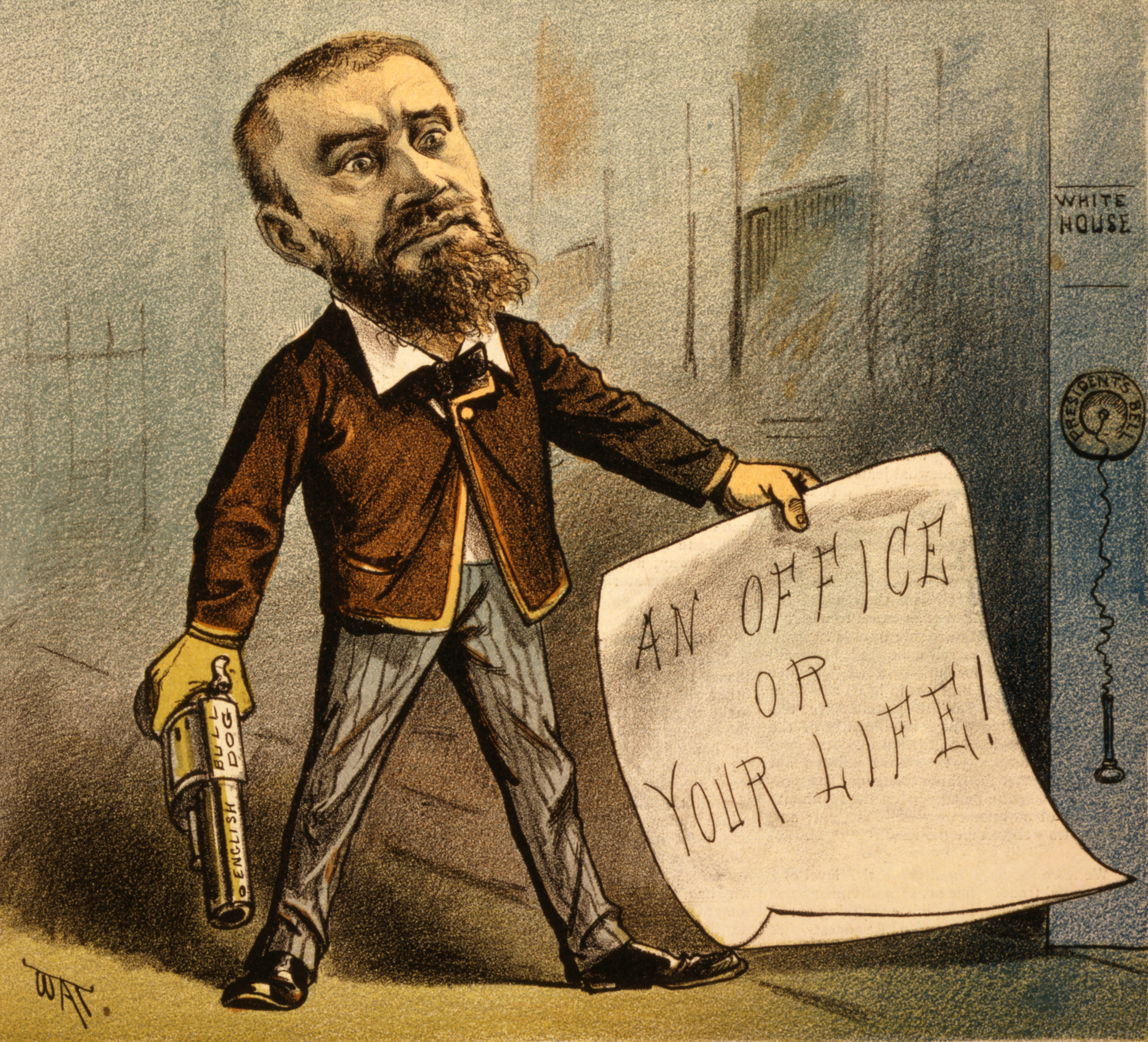
While you all are busy celebrating Independence Day here in the United States, Bahia, or Belarus, take a moment to reflect on poor old James Abram Garfield, who was shot on this date in 1881 by Charles Guiteau.


Apparently, Garfield (who had the second shortest presidency after William Henry Harrison) would've been one of our better presidents if he had lived. Nevertheless, he appointed more Supreme Court Justices than presidents Carter, Taylor, or Johnson. President Garfield argued for a bi-metal monetary system, modernizing agriculture, educating the electorate, and greater civil rights for African Americans. He also proposed civil service reform to decrease the number of jobs filled due to political patronage. However it was not until his assassination that these reforms would get the necessary push to be passed. Charles Guiteau, who had expected a job in the government for supporting the Republican Party's nominee, took out his frustrations by shooting Garfield. The president would later die of his wounds on September 19th.  


Before being featured in the musical Assassins, Charlie inspired a folk song about his exploits:


On an unrelated note, today is also the 140th anniversary of the fall of Rome to the Italian Army.

Monday, June 27, 2011

Pandora Failures

Readers of this blog might wonder if I do anything other than write poetry all day and send it off to places. Well, if you've been reading my other blog, you know that I've been braving the Internet to find myself work, up against limited opportunities and treacherous scammers. But let it be known, that I do have interests other than poetry and writing. One of these is music, not writing or performing it, just listening to it. A couple of months ago I wrote about my attempt to listen to the 1,001 albums considered by some to be the definitive listening experience before one dies.


Now that I've finished that project, I listen mostly to Pandora. For those of you who don't know, Pandora is an internet radio station that uses the music genome project to match a listener up with songs they would like based on what they have previously enjoyed. Most of the time it works well. Rather than finding music at random or playing what is popular, Pandora guides me through songs that are selected just for me. Through it I've discovered John Fahey, Starfucker,  Charlie Poole, and Royksopp, among others. However, the system isn't perfect. I spend a lot of my Pandora time listening to funk and I think I may have exhausted the system's capabilities. Either that, or some weird reverse Affirmative Action is taking place. Interspersed between songs by Parliament and Funkadelic is music by Hall & Oates or Steely Dan.

The main issue with the system though, are the ads. Now, I understand there is no such thing as a free lunch and Pandora has to support itself somehow. However, if a company is trying to support itself with ads, I think it should be concerned with which stations are playing what. While the music is personalized, there does not seem to be any concern with finding out the right demographic that would actually use the particular good or service being offered. If Pandora is going to grow and bring in more revenue, it is going to have to target better. That won't solve the quality of the ads, but what can you do? Radio advertising is always terrible. Without access to images or much of the listener's time, advertisers on the radio have to hook a person's attention quickly, often by means of a jingle that worms itself into the brain. The effect is like being backstage and listening in to the shittiest vaudeville acts you can find.

Nevertheless, from pandora's point of view, the targeting is more important.  While there are people who have a variety of musical tastes and have patterns of consumption that are hard to track (i.e. me), most people's spending habits and musical tastes can be correlated one way or another. Instead, Pandora sends out ads indiscriminately in hopes of hitting someone who might buy something. It is the same strategy used by cicadas when they emerge after years in the ground as a huge brood of slow flying meals for other animals. Sometimes that ads aren't simply misplaced, they seem to run counter to what the fan base of a given artist is probably like.


Now maybe I am just unfairly going into stereotypes. But I would like to think that the fans of eccentric American guitarist John Fahey are not on the lookout for a body spray that will make them smell just like Carmelo Anthony. Nor do I think the marines will find new recruits by playing ads in between songs by Joanna Newsom. I could be wrong though. But there are some ads that are plainly misplaced. At one point, I kept getting commercials for a service that would offer me deals on all the best places to dine, shop, and visit in Boston. I can't imagine why a company would pay for such advertising that would be broadcast to the rest of the country. Maybe it was planted by the FBI and it was a way to entice Whitey Bulger out of hiding by getting him to come back to Boston for a good deal.

Then there are the iced tea ads for Turkey Hill Iced Tea that come on my funk station. Of course, there is nothing unfunky about iced tea, but the voice of the man they use is irritating and creepy. When he says the word "cold" he drags it such a way that instead of feeling refreshing, it reminds one of Siberia and gulags.