Wednesday, April 25, 2007

Paul Giamatti and I

On Saturday I went on a cruise organized by my favorite people in the world, the Inter-Residence Hall Council. My ticket was free because I have a position within it. I went alone since Natalie didn’t have, in her opinion, anything nice to wear to the event. While I was on board the ship, we went up and down the East River and while Sinatra’s New York, New York was playing, we saw Lady Liberty.

When we got back we were detained for half and hour or so because some had stolen a bunch of gift certificates that we were handing out. They were to starbucks, worth five dollars each, and we were all going to get one. The thieves took about three-hundred dollars worth of them. So, we weren’t allowed to leave the boat for half an hour or so. Luckily they found the thieves, two girls who were drunk and who handed the police fake IDs.

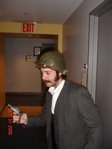
While I was quarantined or whatever, I was with a group of students and we talked about many things. One topic of conversation that came up was that it was claimed I looked like Paul Giamatti, the actor. His best known role is probably in the movie “Sideways.” Let’s see the comparison:


and this, in case you were wondering, is me:


No not the Spainard in the painting, the handsome man in the three-piece suit. Hmmm I suppose there is some likeness in the beardal region, but I'm not seeing it. Maybe the beard is too long. I think our eyes could be similair, dark. Other than that, not much else. Maybe it was the sea air that warped people's vision.

I've also been compared to matthew Broderick and Toby Maguire. But that is when I don;t have a beard, which is rare. I recently found out that besides sharing a birthday, F. Scott Fitzgerald and I also are the same height. We also both like to drink, although he liked it a lot more than I do and probably ever will.

Sunday, April 22, 2007

End of a Marriage?

One of the byproducts of a having a two party system is that in order for a party to govern, at least in the long run, it has to build a coalition of several groups who pledge to support the organization in exchange for either patronage, programs, or policies. Coalitions are helpful because they help to stabilize a party’s long term prospects. Without them, a party runs the risk of becoming dependent on the charisma of its candidates and the regional blocs they can deliver. The problem is neither of these are guaranteed, and relying too much on one candidate can lead to their dominating the party so that it becomes merely an extent of themselves. Ross Perot and the Reform Party, Nader and the Green Party, and Wallace with his American Independent Party are all examples of this.

However there is the problem then of coalitions, namely keeping everyone with it satisfied. In Multi-party politics this is somewhat easier. Despite the fact that there are many parties, once one has entered in as a member of a coalition, it is harder for them to leave. The party gains offices and power and is reluctant to give these up, so it advocates on behalf of the coalition to its supporters and will only leave if things get bad enough or they are made a better offer from a rival coalition. In our system, when a coalition of interests groups is formed, there are few perks that can be offered, since there are weaker ties between the party and the members of its union. When a group is offended by the party, it has the option of not only voting for a rival, but also forming a new party, trying to take the old party over, or simply not voting. Since the groups within a coalition in this country are looser, they can easily slip away or find themselves in conflict with other groups under the party’s umbrella of inclusiveness.

This is the problem the GOP is facing now. For the past three decades the party has functioned through a coalition of conservative Christians, business interests, and voters whose positions are determined by issues revolving around Law and Order. The business and law and order wings of the party were traditionally members dating from after World War Two, but the religious right was needed to help mobilize the votes to bring the party into power the way it was before FDR. The law and order vote helped to break ties with the Democratic Party and the business wing of course supplied funding.

It was a good marriage at first. The older Libertarian wing of the party was somewhat shut out but was kept in line with lip service and the threat of a “socialist” Democratic Party. The coalition captured the presidency and then took over congress and many local governments. However like the FDR coalition of Southerners, Blacks, and the Working Class, the “Reagan Coalition” would start to crumble because of its own internal contradictions.

The 2008 election I think will show the beginning of an unraveling of the Republican Party. No candidate seems to be able to please all the major factions, and the party is torn over trying to adopt positions on a number of issues. Illegal immigration is pitting the Business Wing and Libertarian wing of the party against its law and order wing. Gay rights and abortion are contentious with the Religious Right and the Libertarians. The Patriot Act and the War in Iraq, as well as the ballooning deficit are also sources of conflict. Unless a candidate can come forward with the charisma Reagan had, I foresee a difficult election for the Republicans.

On Poets and Poetry

Why am I poet? Because I write poetry. A better question to ask is then, why do I write poetry? This is much more complicated. As long as we allow a place for poetry in our culture, then the place for poets is safe. But if poetry is threatened, and poetry disappears, the poet becomes in Soviet jargon, “social parasite.” Therefore we can see that what justifies the poet’s existence is not their being a poet, in upholding some sort of essential poet-ness, but rather in producing a certain kind of work, a poem. All the stereotypes and clichés we might have of how poets exist and what they look like are such because only one thing makes a poet, and that is the poem.

The poet must also remember the poem is a creation which lies between music and prose. It is able to contain discrete meaning through words, but at the same time it is dependent on the impression of each word and how they interact with the ones before it. There can be no useless and unconnected parts of a poem, there should be no tangents if possible. In prose this can occur but in poetry economy of words is key.

It is the work which defines one as a poet. The poet of course supplies the raw labor necessary for the poem to be formed and become part of reality, but knowing anything about the poet is irrelevant. It might spur certain interpretations and can be helpful know, especially for those who want write poetry themselves, but the poem can stand on its own without the help of the poet’s personality. Anonymous troubadours and bards have handed us down poems that are still part of the Western cannon such as Beowulf. The identity of Homer is such a mystery that we might consider the Iliad and the Odyssey to be part of this tradition as well. These poems are lucky in a way not to be burdened with a real authorship, for then they can be appreciated on their own without reference to a body of work or the aura that well known poets carry around themselves and tends to blind the critical eye when appraising their work.

The poet should feel liberated by this humility towards the importance of the work. It allows the poet freedom from worry about being original and outside of tradition; nor that they have to develop and remain faithful to some sort of “voice.” Instead the poet becomes a craftsman, a maker, and less of a personality. It must be remembered though, he or she can still aspire to the transcends responsibilities David Citino identifies in “The Eye of the Poet,” to be a visionary or a namer of the nameless.

Most important for the poet is the liberation from the voice. A poet who focuses on the work and lets the work speak through him or her, is freed from that search which often preoccupies younger poets. The poet must be like a charismatic preacher, able to speak in tongues, adapting to every poem and willing to write the same poem in more than one way, to examine thoughts of heartbreak in the sonnet form and in free verse, through a rambling style or one that is more reserved.

T.S. Eliot’s Prufrock might be an extension of his own thoughts on the nature of fleeting time, but the character is not a confession. Instead Eliot conceived of the poem’s subject and found a voice who could speak amply on it. Prufrock was much older than Eliot was when he wrote the poem, and one who was far more experienced in the world of one night stand, “in cheap hotels.” Eliot’s masterpiece, “The Wasteland” also shows the freedom and creativity to be gained by finding out different voices which can challenge the author. He speaks as both the blind prophet Tiresias and as a tarot card reader. He turns from rhymed verse to every-day speech. It should be noted that the original title of the work embraced this principle, “He Do the Police in Different Voices.”

Like an actor finding a character within, the poet works to find the voice. But it is still one voice out of many, not a unitary way of engaging the universe and the culture in dialogue. Even if the world is of one mind, as poet Li Young Lee would have it, still this mind must have its various ways of speaking to itself so that it might proceed to greater understanding and the poet accomplishes this not only for the society at large but also personally when they try to speak in different voices through their work. Poetry when done this way then opens up different ways of seeing and helps the poet speak for those who might not otherwise be able to.

However poetry, as T.S. Eliot might have it, is not a refuge from the self. The progress of a poet need not be a “extinction of personality.” Instead poetry should broaden the personality of the poet, it should help the poet to find him or herself in many places, times, and minds and if done properly can also send the reader there as well. Of course no poet can speak in an infinite number of ways, but they are severely limited if they can only use one.

The problem of speaking in one voice comes through especially with the more confessional poetry that details the obsessions and past crimes of the poet. Many good poems have been and can be written from the subject matter of the writer’s life and their experiences, but simply being honest about the past does not make a poem good. The principle that the work is more important than the poet still applies. The facts add nothing by themselves. Rather they must conform to the flow and the music of the words. The poem is not a database, it is a window and sometimes through a window we do not see everything, either because we can’t or we choose not to. If details have to be left out to help the poem along and keep it from being weighed down, then so be it.

The problem of writing with a personal voice is that it makes editing harder because it feels as if the poet is compromising themselves. Instead of worrying about the work and the craft, the voice takes center stage and limiting it in any way appears to the poet to be a form of self-censorship. If the work is the central focus it will determine already what is necessary and what is not and the poet merely has to trust his or her intuition about the poem.

Politics s not suited for poetry. The bad political decisions of poets should alone prove (e.g. Pound) this but the substance of poetry itself is also problematic. A political poem should understand that it can only treat political concerns in either a direct way or an indirect one. The middle ground of naming names and –isms fails because it reads off a list of details and trivializes contemporary positions and politicians. It uses too much metaphor to describe something that is best argued for in real terms.

However, there can be good political poems. A successful political poetry must either elevate political struggle to pure myth in a dualistic world of diametrically opposed camps or it must be discrete. In the first case it would frame Bush in Iraq as a crusader, going with that as a theme and sticking seriously to it. It would make a commitment to viewing events in that way and then would develop honestly from that point rather than starting with facts and trying to dress them up with a little flourish.

In the second method, the discrete way, the poet is writing about the effect of something terrible and letting this create a passion for solving the problem. A poem about the problems of capitalism would talk about the concerns of miners and their terrible working conditions in order to then inspire an inquiry into why this is going on and lead the reader to further action. But the poem does not preach any solution, it tells about the problem. In addition a political poem could operate by critiquing the language used in politics. It can show the absurd corruption of a word like freedom used to defend tyranny and oppression, or justice used to cover up injustice. This approach goes back to the practical role of the poem, to critique language and how it is used.

If poetry is going to become read again and become popular, it must avoid confessionalism, confrontationism, and esotericism. The work must not be compromised by the poet’s personality as much as possible. The read cannot be treated as the enemy and poetry should not be a shibboleth to separate the educated and uneducated. Attention must turn to the poem and what the poem is supposed to achieve, this sounds simple but many poets have ignored it. All too often they understand what they are trying to achieve but forget they are working with a poem and not an essay or a treatise. They have a limited space and have to select their words carefully.

Of course all great future poems have the potential to be exempt from these rules. It is such works that the rules themselves are built around. They help to define poetry and what the perfect synthesis of word and sound can be. These rules are based on the combined cannon of such works and on the possibilities they open up, but also on the things they tend to do in common.

Wednesday, April 18, 2007

The Duel

We were at a vague intersection,
Where there were no rules only
Customs and accepted behaviors,
Laws etched in silence.

In silence we stood looking
At each other
Facing off across an empty street
Wondering, who would go first?

Who would go first and
Take the road
Seize the asphalt and grind
Prints into its black crystals?

Into its black crystals I went
Timidly,
Trembling before a silver grill
That smiled in anticipation of my steps.

In anticipation of my steps,
The carriage lurched forward
But stopped, unsure if there
Was a sign which I saw and it was blind to.

It was blind to nothing,
There was no sign, only
An understanding that those
Traveling on foot would rule.

Those traveling on foot should have ruled,
The street was ours to take
But we had to take it
No sign would give it to me.

No sign would give it to me,
I did make tracks on my own,
The machine smiled with tin teeth
Understanding how fragile the habits were

The habits of the intersection were
Trampled under the treads of the
Carriage which held a man prisoner,
In yellow chains.

A man, prisoner in yellow chains
Looked at me,
Dragged through the intersection
By a chariot he could start, but not stop.

Not stopping, he conquered the street,
He took it away from me and all
Others traveling by foot, took
It because we were at a vague intersection

Thursday, April 12, 2007

I got a Story Posted

Read a story that I got posted called "Under the Half Moon" about what New York might be like if the Dutch were still here at Flashes of Speculation.

My 15 cents

I was sitting at a deli, overlooking a park and some Greek revival townhouses when I saw a homeless man asking people for change. He passed in front of me as I drank my hazelnut coffee and bagel loaded with copious amounts of cream cheese. The man then turned and entered the deli asking for money for a sandwich. I didn’t know where he was throwing his voice and so kept my focus on my meal, choking on the great globs of cream cheese oozing between the pieces of severed bagel that I was stuffing into my mouth. The homeless man spoke louder and I turned around. He mumbled something about respect and I tried to apologize to him but I wasn’t able to, due to my inability to swallow what I was eating. Like all beggars he “just wanted a sandwich,” and though being a college student living on a fixed income, I was willing to help him out. In my pocket I had some change, I wanted to save the quarters for later, they would help me get a bagel or croissant from a street vendor, but I had a dime and a nickel, 15 cents that I was perfectly willing to give to this man so he could go and buy himself a meal. I knew I wasn’t going to use it.

As I started digging, a look of disgust filled his face and suddenly he didn’t want anything to do with me, or my 15 cents. “No man put it away , I don’t want it if you’re gonna be like that…” he then stumbled out and walked down the street, heading towards Union Square. At first I shrugged, “Well, it’s your fifteen cents…” I don’t know if he heard me. As he escaped the last of my sight I wondered what the problem was and if I should exit from the deli through the other door and loop around the block to avoid him. I decided against it, it would be cowardly and there was no reason to be afraid of the beggar, who for some reason was too proud to accept money from me once asking for it. So I left the deli and noticed that despite what conclusions and resolutions my mind had reached, my body was heading out the exit that would lead away from the path of the homeless man.

Fate thwarted my body however. As soon as I was outside and standing before an old grey stone building, there appeared in the sky a dazzling display of walling mist. It sparkled like gold in the air. At first I was drawn to it, think naively it was snow, then n fear that it might be something flaking off the building, then I was unimpressed by it, watching the droplets fall and soak the street. So I changed direction and walked up to Union Square, following the man who had rejected my 15 cents. Turning the corner I found myself in the middle of the labor day art bazaar lining the streets and setting up. Painters and sculptors and weavers were setting up canvases and statues, flowers and cityscapes, traditional and abstract, solemn and nude, in front of me. I felt lost in a jungle of broad strokes and solid lines. The man was nowhere to be seen.
As I walked a few more blocks and saw Union Square coming into view, hearing its traffic and flow of people, I managed to let the sound of another beggar shaking a plastic cup come into my ears, and then after pausing to look at him huddled in a corner covered with the ruins of posters and past graffiti, into my heart. I decided to let him have my fifteen cents, to see if there was something about me personally which all disadvantaged people find despicable and make my generosity feel like a theft. So I stopped before the man and began digging in my pockets for the dime and nickel which had been seen as dirty money only minutes before. The homeless man took it happily and blessed me, I could not have gotten a more heartfelt benediction from the pope himself.

Perhaps as in all things it was about location. One disturbed me while I was trying to have a private moment in front of the City and the other gave me something to do while making a trip. I suppose my faces and attitudes, the tone of my voices and the positions of my hips and shoulders, the angle of my neck, were different. Or maybe the other one hated nickels and dimes as much as I do.

Monday, April 2, 2007

Unfortunately, my dream came true

Last night I had a strange dream

I dreamed that I was in some coastal town. There was a beach, but it was seperated from the main part where everyone lived by a high cliff. If was a colder place, possibly in the Pacific Northwest or New England. There were no palm trees or coconuts. Instead there were evergreens. I went to the beach and it was fine. There must have been a spring or a current nearby because then I was able to play in the water.

I went back up to the main street as the beach started to fill up with people. The shops were all very nice, almost too nice in that way that re-created towns look. Suddenly a warning siren rang and I looked out towards the ocean and saw to my horror, the water rolling up in a massive wave.

It was huge, colossal. The sun shone on it and it looked like a skyskaper made of glass that as hurling itself towards my little town. I could hear the people on the beach screaming, trying to run to the high ground. I was there and so I had a real running start. What was interesting was that I actually felt real horror when I saw the wave, I was there. Also I was able to run away from it. Usually in such dreams one is stuck and cannot move. However I could and I ran and ran.

Luckily for me I ran far enough inland so that the wave did not reach me. It hit the shore and smashed aainst the cliff, then part of splashed to the tip of the town, none of it got me wet. I woke up after that. I think that maybe the dream was inspired by a picture I saw in the most recent Guiness World Records,in which the largest recorded tsunami had its size demonstrated by taking the empire state building and showing the picture of a wave done in traditional Japanese fashion next to it. In other words, this wave was huge.

Unfortuately this morning, I found out that a tsunami had hit the Solomon Islands, real beaches were hit and real people were killed.

Sunday, March 18, 2007

Confederate Flag Controversy


They should at least be happy that it's being used as high art.

In an art gallery in Tallahassee, an artist has created an exhibit called, "The Proper Way to Hang a Confederate Flag" which is a confederate battle flag hung in a noose. Personally i think it is provocative, maybe the artist, John Sims should have hung the noose from a tree instead of a gallows because of the connotations of lynching, but I think it is fitting.

Of course the sons and daughters of the Confederacy are in protest over it and apparently it violates a state law that you cannot defile or desecrate the confederate flag, odd that the symbol of an anti-constitutional rebellion is given basically un-constituional protection.

Florida is the last place I would think they would have any sort of feeling for the flag. There were few people there when they joined the rebellion in the Civil War and practically few battles were fought there. If they had won, most of the people in Florida would not be there today. I can't image the Cubans wanting to live there if they still had slavery nor would old Jewish retirees from new York want to head out there either, I would think.

The flag should be considered offensive by everyone, not just because of slavery, but because it represents a group of people who were unhappy with the constitution and pouted and threw a fit and a temper tantrum called the Civil War. The South was run by an aristocratic slave owning elite that essentially were a bunch of crybabies who wanted to run everything in this country and when they saw they wouldn't be able to because Lincoln was elected, they shut themselves up in their rooms and refused to come out.

Remember General Lee killed more Americans than Osama. And don't think because he claimed he was fighting for his state (which I hale originally from, his house is the symbol on my county seal) that his armed struggle was serving just that ends. The nascent country was founded on slavery and slavery alone. State's Rights was not the issue. Anyone who disagrees can read the cornerstone speech. The South didn't care about State's Rights in the War of 1812 and the Mexican American War. It wanted Northern States to prosecute those who helped runaway slaves. They loved the federal government AS LONG AS THEY COULD RUN IT.

And Southern Heritage? What the hell is Southern Heritage? It's an excuse to hang the flag because the young people seem to no longer have been born with an inbred hate of Mr. Lincoln and the sons of Cain. Remember, not all Southerners fought for the Confederacy, many took arms against it. Remember the Black population of the South and how it is a part of that heritage as well, and that they shape how it is defined. What is this Southern heritage? Going to church? People everywhere do that. Respect for property? Seems common too. Owning firearms? Eating the cuisine of the region (which has many sub-variations so I can;t see how this is a "cornerstone" of their heritage)? Despite the accent, the Southern language is not really a dialect and certainly not a separate language. There is certainly a corpus of Southern Literature, but I doubt many of the people who protest the flag have read Faulkner and O'Connor.

The South is a land of many strong, passionate people who have built this country and have struggled to try and overcome the past. Those who would defend the flag and bring it into the Pantheon of essential "Southerness" jepordize the movement away from the scars and battlewounds and threaten to turn the progress of the last century and a half of progress into a lost cause.

(Photo credit of Phil Coale, AP)

Thursday, March 15, 2007

A poem I wrote on Poetry.com

This was using the daily poetry contest:

Prelude

Struggling faces disappear
Inside trapped masses crawling
From the withered blade.
Waterlogged voices against damned bones,
Gurgling remains of dried blood,
The world vanishing cries:
Echoing dirty silence.

Poetry.com

I stumbled across a website called just that a few days ago. Seems interesting. They give out all this prize money for people who submit poems. I wonder exactly how they raise it. Maybe its a front and the people who win are laundering money. Chi sa?

I have sent in some poems for the daily contest they have. You take some of the words they give you (20 max.) and you pen a little ode with them. It's difficult, especially with the words they have today because they're in French. I suppose I could just string them together and that might help me to create something that sounds great but means nothing.

They have a monthly competition as well and I submitted my poem about politics "Correctness" to it. It's one of the few I have that is less than twenty lines long. They should have a competition for epic length poems.

Also I have been playing around on a site that sell magnetic poetry. It actually is better to do it online than on a fridge I think, better for your back and hands and the pieces move a lot quicker.

Tuesday, March 6, 2007

Parodies of particular beliefs

I like the list that Wikipedians have compiled of religious beliefs that are parodies, especially the last one.


The following were created as parodies of particular religious beliefs:

Church of the Holy Donut, sermons by talk radio host Bernie Ward parodying the religious right in the US.

Eventualism, a subtle parody of Scientology.

Flying Spaghetti Monsterism, also known as Pastafarianism, a parody of intelligent design.

Kibology, a humorous Usenet-based satire of religion, partly parodying Scientology.

Invisible Pink Unicorn, a parody of theist definitions of God. It also purports to highlight the arbitrary and unfalsifiable nature of religious belief, in a similar way to Russell's teapot.

Landover Baptist Church, a parody of Evangelical Christianity.

Last Thursdayism, a joke version of omphalism, again demonstrating problems with unfalsifiable beliefs.

OBJECTIVE: Ministries, parody of Christian fundamentalism.

Christianity, parody of Judaism.

Thursday, March 1, 2007

I'm into Free Food

Maybe its an addiction. Maybe it just makes common sense. But whatever it is, I love free food. If an event is giving something to eat away, I will be on top of it, I will be there early, and I will push anyone out of my way. It might be the caveman inside me, the one who tells me to grow facial hair. I am constantly preparing for winter, even though I don't hibernate.

A few weeks ago they had on campus an event for everyone who uses campus cash, to come See what the vendors were offering, and who takes it. I pretty much am the king of using campus cash, of all my friends I am the only one who uses it regularly and I'm sure I keep the system afloat, at least at certain locations. The deli in the basement knows me as the guy who flashes the NYU id to pay for everything, including a slice of toast.
Well this event was a dream come true. For some reason there were dozen Mexican places represented, so I had my far share of Mexican food. I got certificates for three free burritos from Chipoltle. Pizza mercato served up slices of pizza. There were coffee, pastries, cupcakes, cookies, falafel, and my very favorite (I cannot underestimate in saying how happy this made me, I'm easy to please) a surprise of paella being dished out. They were giving us saffron and seafood!

Yesterday was Ultra Violet Live and afterwards there was free food. My friend Sue and her roommate Brittany liked that I came along with them to the top of the Rosenthal Pavilion, it made them feel better about themselves to see me with two plates loaded with mozzarella sticks, egg rolls, chicken wings, cheese, and crackers. In my defense I hadn't eaten all that much, except two bagels at breakfast, which were paid for by the local hall council. Yes, after the breakfast was over I snagged a couple of free bagels, but there was no one else there to take them.

One of the highlights of the evening was the fact that Josh H. a friend of mine from good old high school, was one of the judges. It was weird to hear his voice again, but good to know that he hadn't vanished completely off the face of the earth, or worse, totally immersed in LA. I wanted to see him after the show but he didn't come up to the Rosenthal Pavilion on the tenth floor of Kimmel, to watch me stuff my face with all matter of fried cheese and dairy products.

Monday, February 26, 2007

Bill Takes Swing at Fake Bull Testicles

The story itself is italicized:

ANNAPOLIS, Md. (Feb. 22) - Fake bull testicles and other anatomically explicit vehicle decorations would be banned from Maryland roads under a bill pending in the state legislature.

Hmmmm, I wonder if someone felt jealous.

The measure was filed in the General Assembly Monday by Delegate LeRoy E. Myers Jr., R-Washingon, who says children shouldn't be exposed to giant plastic gonads dangling from pickup truck trailer hitches. The bill also would ban depictions of naked human breasts, buttocks or genitals, with offenses punishable by fines of up to $500.

Of course it s proposed by a guy with the name “LeRoy” it means “the king!” He wants to rule with an iron fist! He wants his will to be known! But he’s just doing it for the kids.

"It's time to take a stand," Myers told The (Hagerstown) Herald-Mail.

Yes, YES! Yes we must take a stand! On what? Against fake bull testicles? Ah hell sure, why not? I’m for laws. I’m for order, ad I’m for REAL bull testicles hanging of the car, none of this fake stuff. The law should allow only natural, God made testicles to be hung from a car. And you have to get them yourself, no being a pansy and getting someone else to do it.

The American Civil Liberties Union objected to Myers' bill.

Of course….

"The legislation is overly broad, and would probably make it illegal to have a sticker on your car of the Venus de Milo from an art museum," ACLU of Maryland spokeswoman Meredith Curtis wrote in an e-mail.

Yes but no one is going to be aroused by her, she’s got no arms! Do they even sell such things? The only magnets I see are of impressionist paintings, but if you stare at them hard enough and long enough, what do you see, A massive penis! Well at least I do…

Pamela Campbell whose Bullhead City, Ariz., business sells fake bull testicles, suggested that the swinging decorations can prompt healthy discussions about anatomy and reproduction.

She lives in BULL-head and she sells BULL testicles, I refuse to believe that. Like I said, it should be fine as long as they are real and not pale imitations. We shouldn’t mislead the kids. There can only be a healthy discussion if the real thing is used, or your own testicles.

"Do we have to neuter all dogs that walk by us?" she asked. "Where does it stop?"

Well my face isn’t usually stuck looking at a dog’s ass for two hours trying to get to the beach.

Last week, Arizona's legislature rejected a measure that would have banned vehicle splash guards bearing racist terms or silhouettes of naked women.

If the truckers object, then let them look at silhouettes of Gay men haivng sex, not just any kind of sex, but GAY GAY GAY sex.

Copyright 2007 The Associated Press. The information contained in the AP news report may not be published, broadcast, rewritten or otherwise distributed without the prior written authority of The Associated Press.

Well who can really own the news?

Friday, February 23, 2007

Subway Poem 1#

In the Aether

Here it comes,
Here it comes,

Air!
A clear wave hits me,
Ripples from the train
Splash the walls of the station,
And wash away
The heat and the steam.

The air moves around the station
And sits.

It takes its time and waits for the next train,
Slowly becoming absorbed
In the conversations abounding
Between rotten fruit and empty bottles,
Armpits and bread crusts,
Grease sizzling and gleaming on the ground,
And the water pooled between the tracks.

It joins them all and wears them all,
One smell on top of one another,
Weighing itself down and growing heavy
In the fluorescent lights,
Waiting to be taken away,

Getting thicker,
Getting thicker,

Gas!
It is sticking to me,
The scents of the world
Dumped in this cement basin
And mixed with exhaust.

Moments rolled up
In crumpled napkins unfolding,
Rise up and sink once more,
Cycles mirror the days and make
Memories flow like incense
And my breath, I can taste it now,
Becomes dense and solid,
As coffee cups and dirty socks
Come up into the air and dance, oh

It all reeks of people moving too quickly,
Of people getting stuck,
Of people wandering, lost.

What is coming?
What is coming?

Light!

The ground is shaking,
Loud noises sputter from speakers,
The gas moves and becomes fluid,
It readies itself for making waves,
And blowing the old scents away.

A new breeze is arriving,
For a light, coming from away
In the dark, is moving near
And shines on the iron rails ahead.

Tuesday, February 20, 2007

Come Together

It is interesting how in the this past month two tragedies have happened to people I grew up with back home in Arlington and how this has brought everyone together from across the country, at least in theory over the Internet.

My friend John McMahon suffered an aneurysm in January. he is doing much better now, though he still needs to recover. he can recognize faces and can eat and do some walking, which is good considering that originally the doctor's were not sure if too much of his brain had been damaged to save him. I sent John a car a few weeks ago. I knew his parents would read it so i didn't write anything inappropriate or make an inside joke.

But a community has sprung together over his being sick and they have been communicating with each other. On Facebook there is a group dedicated to exchanging information and showing support. People have gone back and visited him in the hospital though now I think because he is starting physical therapy they are trying to keep those visits to a minimum. My main conduit for information is my mother, who forwards me updates on his condition.

I haven't talked to John in a while. We both had a rough year last year and the year before that. For different reasons, but still things were difficult. He dropped out of VT and I developed Crohn's disease. Not fun. Only recently have things started to really come together for me, and I haven;t been in touch with John. There have been a few IMs but nothing much else, which is a shame considering we live down the street from one another.

The other event was the recent death of Joseph Buescher , or Joe as he was known. We went to Sunday school together. Along with John McMahon in fact. Joe went to a different high school than me so I did not know him as well, but I remember what he looked like back when we studied together for confirmation. What was interesting about his death (by a car accident) for me at least is that it brought me in touch with Anthony Buenafe, my Filipino friend who I was in elementary, middle and Sunday school with and who I was on good terms with. We were probably the smartest kids in Sunday School. I joked that our class should have done a better job picking confirmation saints, I said that I was lucky because my saint (Gennaro) is the patron saint of bloodbanks.

Anthony thought that was funny.